

144 W 24 VDC / 6 A rugged industrial Bicker DC UPS IP67 with 99 Wh LiFePO4 battery


144 W 24 VDC / 6 A rugged industrial Bicker DC UPS IP67 with 99 Wh LiFePO4 battery

Rugged industrial DC UPS for outdoor and demanding applications. Provides 24 VDC / 6 A (144 W), features an integrated 99 Wh LiFePO₄ battery, IP65/IP67 protection and an operating temperature range of −20 to +55 °C. More
Code: UPSI-2406IP-26U
Rugged industrial DC UPS for outdoor and demanding applications. Provides 24 VDC / 6 A (144 W), features an integrated 99 Wh LiFePO₄ battery, IP65/IP67 protection and an operating temperature range of −20 to +55 °C. More
Code: UPSI-2406IP-26U
Bicker UPSI-2406IP-26U · rugged backup power supply with LiFePO₄ battery
Protect 24 V equipment and data during an extended power failure
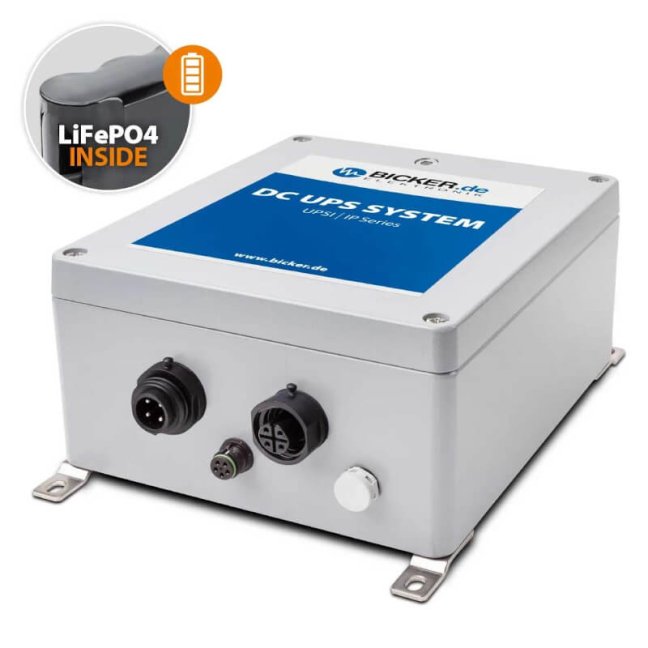
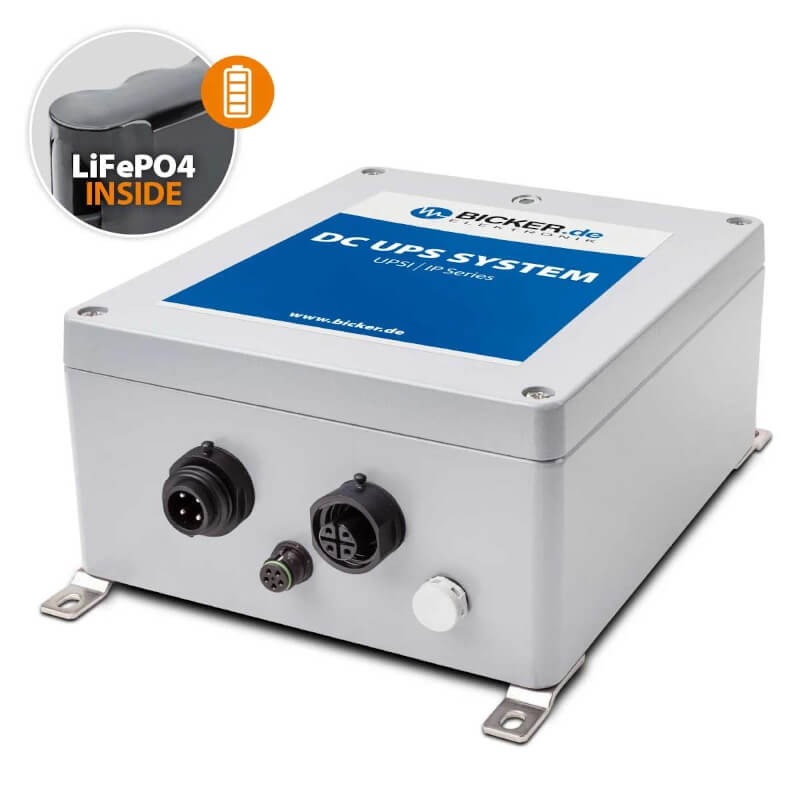
The Bicker UPSI-2406IP-26U is a rugged 24 V DC/DC UPS backup power supply for industrial, mobile, and outdoor applications. Its robust die-cast aluminium design with IP65/IP67 protection safeguards electronics and the battery from dust, dirt, and water. The UPS belongs to the 144 W power class, provides a nominal output current of 6 A and, thanks to its integrated LiFePO₄ battery with a capacity of 7.5 Ah / 99 Wh, offers approximately 31 minutes of backup time at nominal load.
How long do you need to keep your equipment running during a power failure?
Tell us which devices you want to back up and for how long. If you know their power consumption in watts, include it; we will help you select a suitable backup power supply and power supply unit.
24 V technology remains operational during a power failure
The UPSI-2406IP-26U helps protect industrial computers, control and regulation units, communication devices, drives, actuators, sensors, measuring equipment, safety systems, and other devices powered from a 24 VDC branch against power failures and significant supply-voltage dips.
During normal operation, the UPS passes the input voltage to the output, simultaneously charges the integrated battery, and monitors the input voltage. If the input voltage falls below a specified threshold, it switches to backup mode in less than 600 µs.
Output voltage in normal mode is approximately 24 to 23.6 VDC depending on the load. In backup mode, it is regulated approximately within the range of 23.6 to 23.3 VDC. At the nominal current of 6 A, the UPS provides approximately 140 W in backup mode.
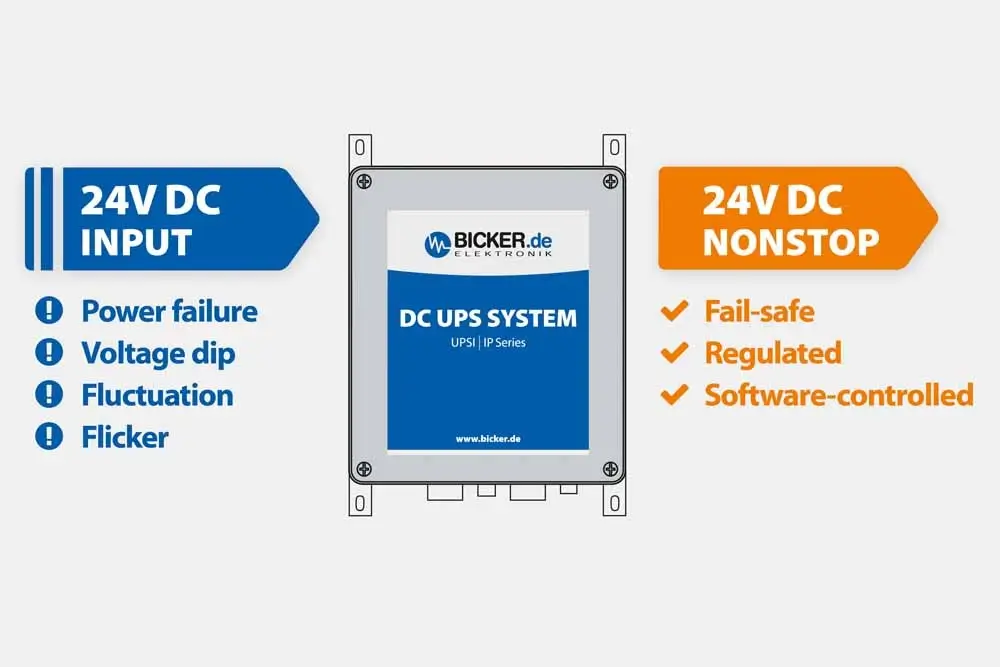
During a power failure or significant input voltage drop, the UPS switches very quickly to the integrated battery and continues supplying the connected equipment.
The nominal output current is 6 A. The 144 W designation corresponds to the UPS power class; at nominal current, the manufacturer specifies approximately 142 W in normal mode and 140 W when operating from the battery.
The UPS can pass information about a power failure to a connected computer or control system, enabling a subsequent response such as safe shutdown.
Rugged design for outdoor installations, machinery, and mobile equipment
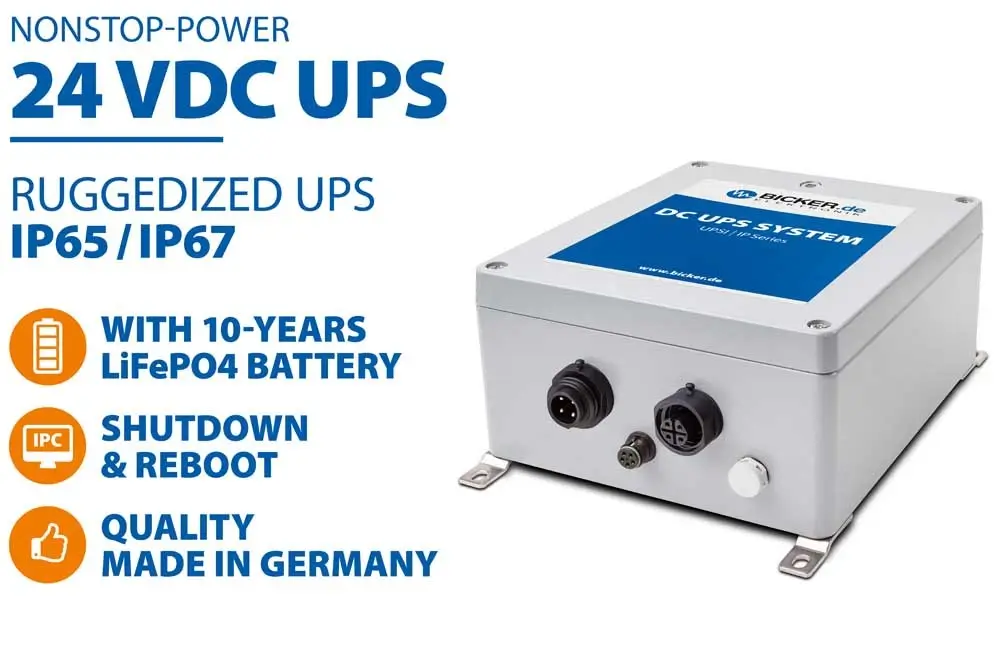
The UPSI-2406IP-26U is intended for applications in which a standard control-cabinet UPS does not provide sufficient protection against the environment. Both UPS electronics and battery are housed in a robust die-cast aluminium enclosure with IP65/IP67 protection.
When wired correctly, its design protects against dust and dirt, water jets, and temporary immersion. The manual permits temporary immersion for a maximum of 30 minutes to a depth of 1 m. The enclosure incorporates a pressure-equalisation element that limits issues caused by pressure changes and condensation formation inside the sealed enclosure.
The ambient operating temperature range is −20 to +55 °C. The maximum permitted relative humidity is 95 % at +25 °C, and according to the current manual, the UPS can operate at altitudes of up to 4,000 m.
The sealed design enables UPS use in dusty and humid environments as well as suitable outdoor applications.
The die-cast aluminium design protects power electronics and the battery from mechanical and environmental influences.
Pre-installed metal brackets enable the UPS to be attached to a machine, panel, wall, or another suitable solid surface without using a DIN rail.
LiFePO₄: long lifetime and enough time for safe shutdown
The integrated BP-LFP-1375 battery module uses lithium iron phosphate, or LiFePO₄, technology. It has a nominal voltage of 13.2 V, a capacity of 7.5 Ah, and energy of 99 Wh.
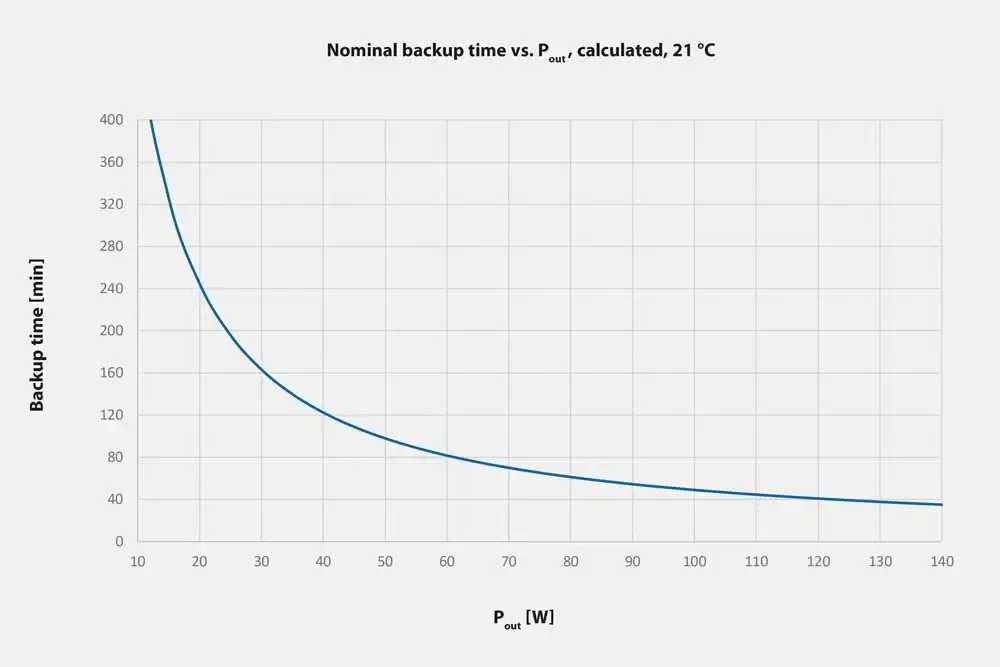
At nominal load, the UPS provides approximately 31 minutes of backup time according to the current manual. At lower current draw, the backup time can be considerably longer. Actual time is affected particularly by load, temperature, battery condition, and the configured maximum backup time.
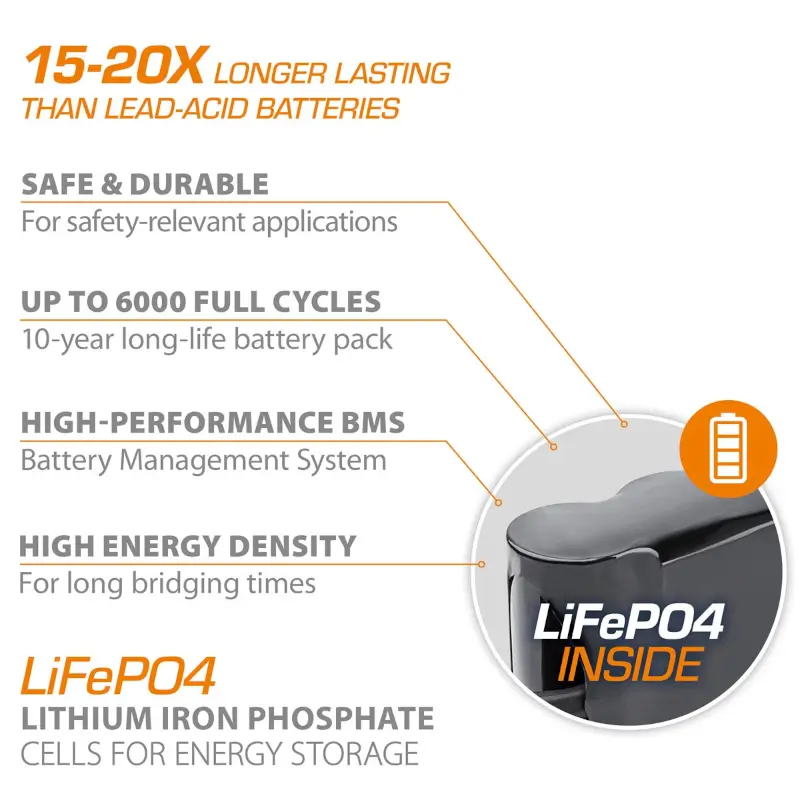
LiFePO₄ batteries offer high cycle life and stable chemistry. Bicker specifies up to 6,000 charge and discharge cycles for this product. The integrated battery-management system with cell balancing helps keep cells evenly charged and use the available battery capacity over the long term.
Monitoring, shutdown, and restart
Controlled computer shutdown and automatic operation recovery
Via USB, the UPS supports the standard HID Power Class. Most supported operating systems can therefore recognise it through Plug & Play as a HID UPS or HID battery without requiring a dedicated communication driver.
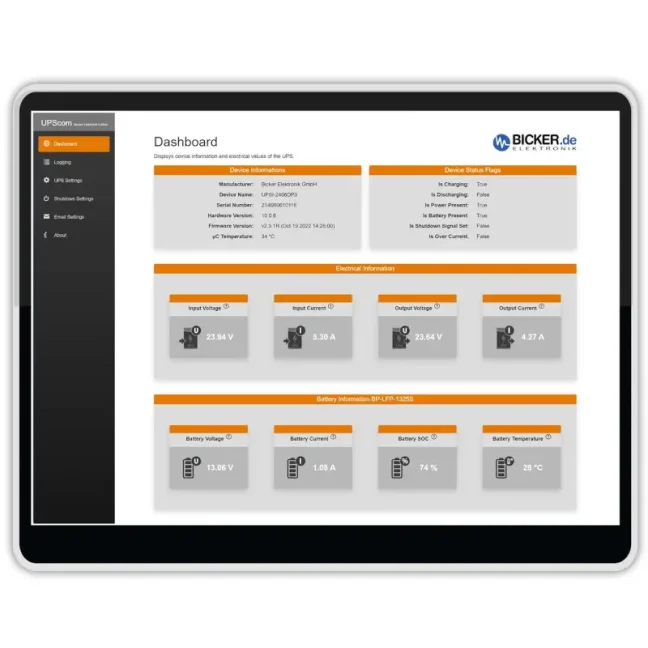
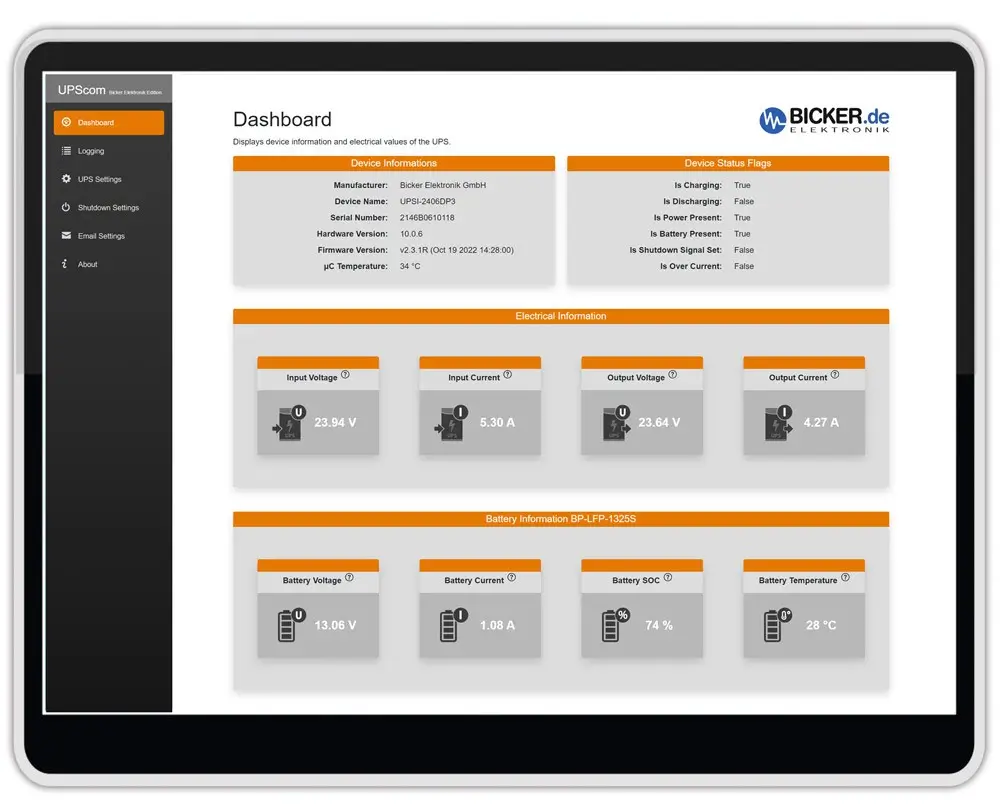
UPS Gen² Configuration Software is used to configure internal parameters. UPScom software is intended for extended monitoring, notifications, running scripts, and controlled computer shutdown.
Configurable parameters include, for example, Load Sensor, shutdown delay, maximum backup time, minimum battery state required before system startup, or restart delay.
The UPS monitors consumption of the connected device. Once it falls below a configured threshold after controlled shutdown, the UPS can determine that the computer has already stopped operating and end backup mode without needlessly discharging the battery.
During a power failure, an industrial computer can save data, close running applications, and perform a controlled shutdown before the UPS disables its output.
The integrated Reboot function enables the output to be temporarily disabled after shutdown is complete and then activated again. The computer itself must also be configured appropriately for automatic startup.
Power supply and installation
The UPSI-2406IP-26U is connected between an upstream 24 VDC power supply and the backed-up equipment. The input voltage operating range is 22.8–30 VDC. The fixed undervoltage threshold is approximately 22 VDC.
For full functionality at maximum nominal load, an upstream power supply of approximately 24 V / 7.5 A, or approximately 180 W, is required. The input power supply must meet SELV or PELV requirements, and the upstream power supply must not use a constant-current function.
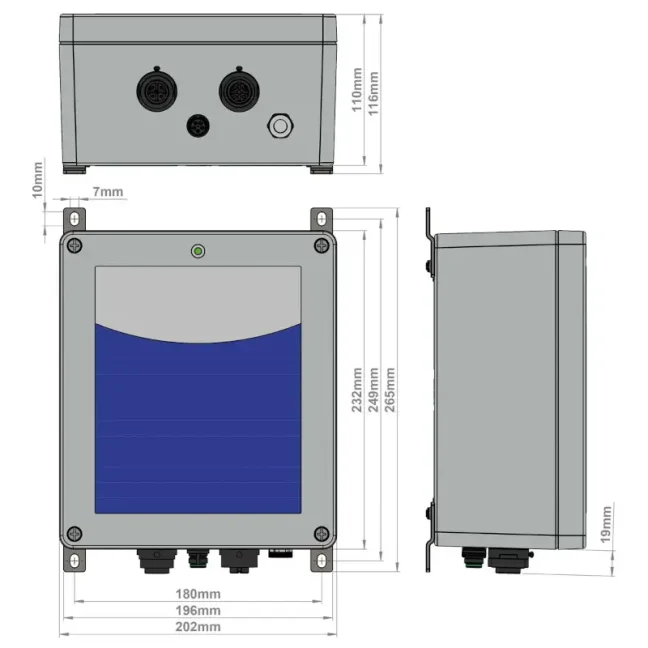
The enclosure itself, without connectors and mounting brackets, measures 202 × 232 × 110 mm. The dimensions including mounting elements are approximately 202 × 267 × 117 mm. The UPS weight is approximately 3.72 kg.
The device is passively cooled without a fan. For sufficient heat dissipation, the manual recommends maintaining at least 100 mm of free space around the enclosure in all directions.
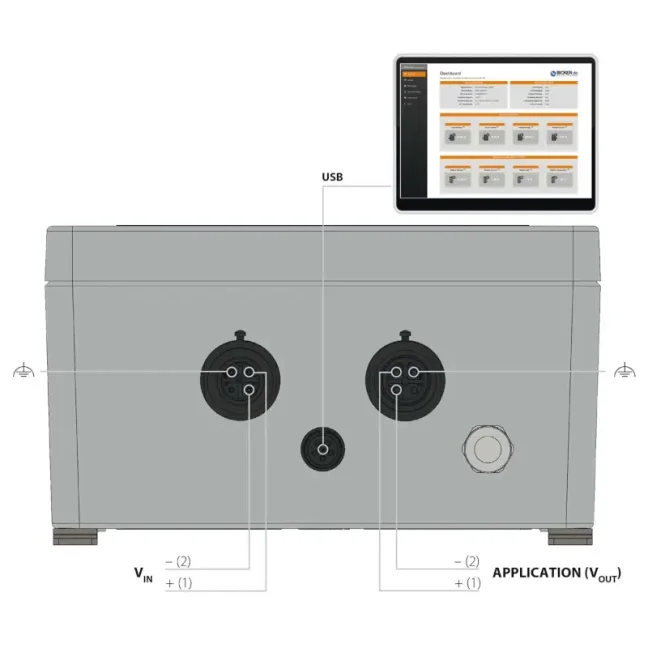
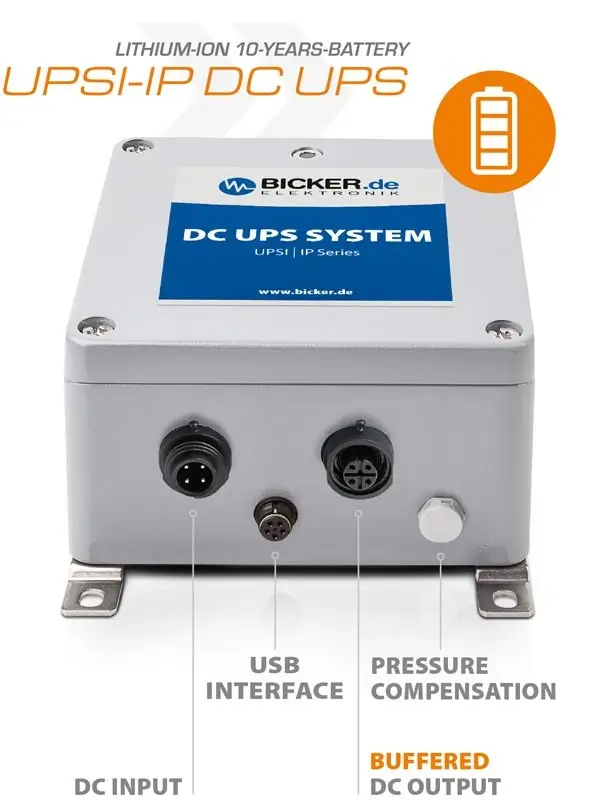
To maintain the declared protection rating, the input, output, and used communication connectors must be properly connected and secured. An unused multifunction interface must be protected with an appropriate cover cap.
Above the nominal 6 A, the UPS can statically supply 6.3 A. Dynamically, it can handle approximately 6.4–7.5 A for a maximum of 3 s. Use the nominal 6 A for continuous operation.
For very short current peaks, the manufacturer specifies the ability to provide up to 30 A for approximately 5 ms.
At the maximum available charging current, the manufacturer specifies a battery charging time of approximately 115 minutes. The time also depends on input voltage and simultaneous consumption of the connected load.
Protection of the UPS and connected equipment
The UPSI-2406IP-26U includes output overcurrent and short-circuit protection as well as active input reverse-polarity protection. Reverse-polarity protection applies if the input is connected incorrectly when the UPS is switched off, for example during commissioning.
If the UPS is already operating in battery backup mode and input voltage with reverse polarity is subsequently connected, reverse-polarity protection is not ensured. Therefore, the polarity of the supply cable must always be checked before connection.
If output current is too high, the UPS disconnects the output. For current of 6.4–7.5 A, a maximum duration of 3 s is allowed; at 7.6–10.8 A, a maximum of 100 ms; and above 10.8 A, a maximum of approximately 5 ms.
In the event of an output short circuit, the output is disconnected in less than 5 ms. In normal mode, the UPS subsequently attempts to restore the output periodically; in backup mode, no automatic restart attempt takes place.
UPS electronics and the battery system monitor the accumulator condition, including cell undervoltage, and prevent continued operation after the discharge limit is reached.
Scope of delivery
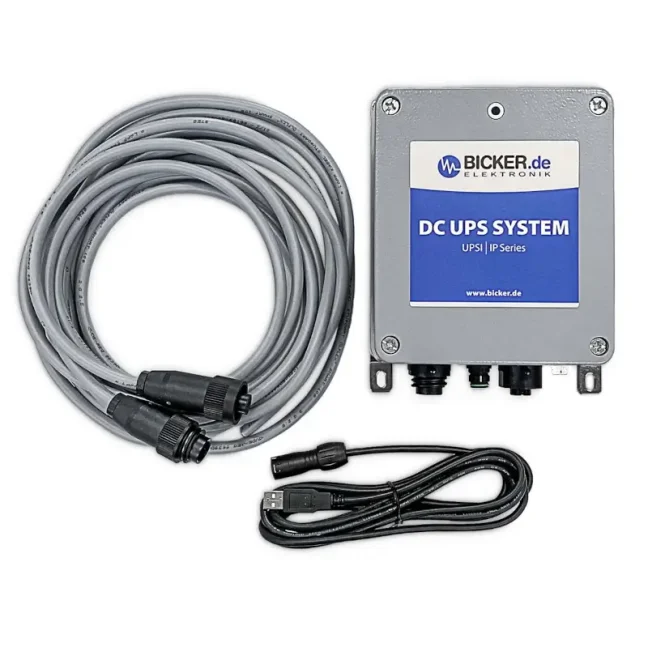
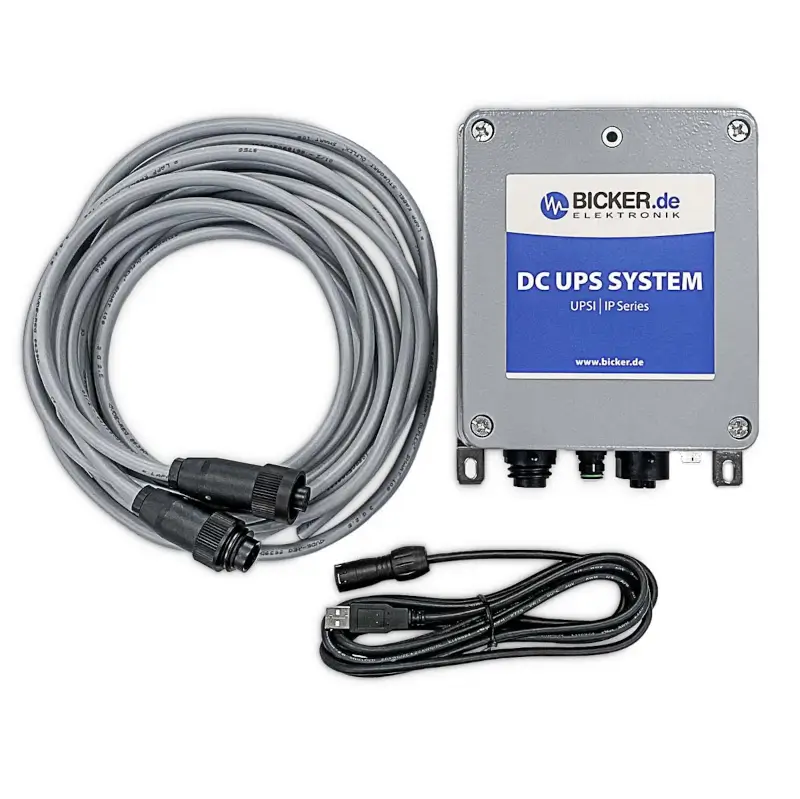
- 1× UPSI-2406IP-26U backup power supply with integrated BP-LFP-1375 LiFePO₄ battery, 7.5 Ah / 99 Wh
- 1× VIN input cable, 3 × 2.5 mm² including functional earth FE, 3 m long, open end
- 1× VOUT output cable, 3 × 2.5 mm² including functional earth FE, 3 m long, open end
- 1× USB cable, 3 m long, USB Type-A connector
The power supply unit is selected separately according to the connected load. The PSZ-1108 cable for relay output, PSZ-1109 cable for RS232, and PSZ-1104 multifunction-interface protective cap are optional accessories.
About the manufacturer
Bicker Elektronik
Bicker Elektronik is a German manufacturer that has developed, manufactured, and supplied industrial power supplies, UPS backup systems, and system components since 1994.
Bicker products are used in automation, robotics, measurement and control technology, industrial computers, communication systems, transport applications, and other equipment with demanding requirements for reliable power. With the UPSI-2406IP-26U, the emphasis is particularly on resistance to environmental influences, high battery capacity, and long backup time for 24 V equipment.
Why buy from FOXON
Do you need long backup time for 24 V equipment?
Tell us what you want to back up, the equipment power consumption, and how long it must remain operational during a power failure. We will help verify whether the UPSI-2406IP-26U with its 99 Wh battery is suitable, and select the corresponding upstream power supply and accessories.
Request a solutionSchedule an online meeting
Do you need advice on backup time, wiring, or connecting the UPS to an industrial computer or other equipment? Choose a time for a short online consultation directly in the calendar below.
Technical parameters
Basic features
- Device type: rugged industrial DC/DC UPS backup power supply for equipment powered by 24 VDC
- Manufacturer order code: UPSI-2406IP-26U
- Input voltage: 24 VDC nominal
- Input voltage range: 22.8–30 VDC
- Output voltage: 24–23.6 VDC in normal mode / 23.6–23.3 VDC in backup mode, depending on load
- Output current: 6 A nominal
- Nominal output power: 142 W in normal mode / 140 W in backup mode
- Battery technology: LiFePO4
- Mounting: on a wall or solid surface; mounting brackets are pre-installed
Backup power and battery
- Integrated battery type: BP-LFP-1375
- Battery technology: LiFePO4
- Nominal battery voltage: 13.2 V
- Final charging voltage: 13.8 V
- Battery capacity: 7.5 Ah / 99 Wh
- Charging method: CC / CV / CP
- Maximum charging current: 4.5 A
- Charging time: approximately 115 min at maximum charging current
- Backup time at nominal load: approximately 31 min
- Deep-discharge protection: 2.4 V per cell
- Backup-time note: backup time depends on load, temperature, and battery condition; it may be reduced at very low or high temperatures
Output and power
- Nominal output current: 6 A
- Static Power Boost: 6.3 A; 149 W in normal mode / 147 W in backup mode
- Dynamic Power Boost: 6.4–7.5 A for a maximum of 3 s; 150–176 W in normal mode / 149–175 W in backup mode
- Short-circuit current: 30 A for 5 ms
- Switching from normal to backup mode: <600 µs
- Capacitive load at startup: up to 3,000 µF
- No-load operation: supported
- Short-circuit protection: yes
- Overcurrent protection: automatic output shutdown when the permitted current is exceeded
Input parameters and power supply
- Maximum permitted input voltage: 35 VDC
- Undervoltage connection threshold: 22 VDC
- Voltage drop between input and output: approximately 0.4 V depending on load
- Input current at nominal load: 6.1 A
- Maximum input current: 7.4 A
- Input current during Dynamic Power Boost: 7.6 A
- Self-consumption without load and charging: <100 mA
- Input current during charging without output load: 2.25 A
- Internal input fuse: 15 A
- Startup time: <5 s
- Recommended upstream power supply for full functionality: 24 VDC / 7.5 A, approximately 180 W, without a constant-current function
- Required power supply type: SELV or PELV
- Input cable: 3 × 2.5 mm² including functional earth FE, 3 m long, open end
- Output cable: 3 × 2.5 mm² including functional earth FE, 3 m long, open end
- Input reverse-polarity protection: active protection against reversed input polarity if the UPS is switched off when connected
Communication, signalling, and functions
- Multifunction interface: USB 2.0, RS-232, or relay
- USB: VCOM and HID, point-to-point communication, communication distance up to 3 m
- RS-232: TX/RX, 38,400 Bd, point-to-point communication, communication distance up to 10 m
- Relay output: potential-free contact, 24 VDC / 1 A
- Relay function: configurable Power Fail or Alarm signalling
- Relay logic: configurable as NO or NC
- Indication: green status LED
- Normal mode: LED continuously illuminated
- Backup mode: LED flashes at 1 Hz
- Protection functions: indication of overcurrent, short circuit, internal errors, and battery faults by the status LED
- UPS functions: automatic switching to backup mode when input voltage fails or drops, and automatic return to normal mode after power is restored
- Software: UPS Gen2 Configuration Software for parameter configuration and monitoring; UPScom for controlled shutdown, monitoring, and other advanced functions
Operating conditions
- Operating temperature: −20 to +55 °C
- Startup temperature without load: minimum −20 °C
- Storage and transport temperature: −30 to +55 °C
- Recommended state of charge for storage: 80 %
- Relative humidity: maximum 95 % at +25 °C
- Maximum operating altitude: 4,000 m
- Climatic class: 3K24 according to EN 60721-3-3:2020-5
- Pollution degree: 4
- Use: indoor and outdoor environments
- Operating note: at higher ambient temperatures, the output-power derating curve must be observed
Mechanical design
- Protection rating: IP65 / IP67
- Protection class: III with functional earth FE
- Enclosure material: die-cast aluminium EN AC-AlSi12(Fe), powder-coated
- Enclosure colour: RAL 7001, silver grey
- Flammability class: UL 94 V-0
- Condensation protection: pressure-equalisation element
- Dimensions (W × H × D): 202 × 232 × 110 mm without connectors and mounting brackets
- Weight: 3.72 kg
- Parallel UPS connection: not supported
- Series UPS connection: not supported
Package contents
- Backup power supply: 1× Bicker UPSI-2406IP-26U
- VIN input cable: 1× 3 × 2.5 mm² cable including FE, 3 m long, open end
- VOUT output cable: 1× 3 × 2.5 mm² cable including FE, 3 m long, open end
- USB cable: 1× 3 m cable with USB Type-A connector
Optional accessories
- PSZ-1108: cable for relay interface
- PSZ-1109: cable for RS-232
- PSZ-1110: USB cable
- PSZ-1104: multifunction-interface cover
Standards and electromagnetic compatibility
- Safety extra-low voltage: IEC 61010-1 (SELV) and IEC 61010-2-201
- Electrostatic discharge: EN 61000-4-2, 4 kV contact discharge / 8 kV air discharge
- Immunity to radiated radio-frequency electromagnetic fields: EN 61000-4-3, 10 V/m in the 80 MHz–1 GHz band and 3 V/m in the 1.4–2 GHz band
- Electrical fast transient immunity: EN 61000-4-4, 2 kV
- Surge immunity: EN 61000-4-5, ±0.5 kV between L–N and ±1 kV between L–PE / N–PE
- Power-frequency magnetic-field immunity: EN 61000-4-8, 30 A/m
- Emissions: complies with EN 55016-2-3 requirements
Frequently asked questions about the rugged Bicker UPSI-2406IP-26U backup power supply
Basic use and backup power
What is the Bicker UPSI-2406IP-26U?
The UPSI-2406IP-26U is a rugged industrial DC/DC UPS backup power supply for equipment powered by 24 VDC. It has an integrated BP-LFP-1375 LiFePO4 battery with a capacity of 7.5 Ah / 99 Wh, a nominal output current of 6 A, and a robust aluminium enclosure with IP65/IP67 protection. It is intended for indoor and outdoor use in demanding conditions.
Does the UPS require a separate 24 VDC power supply?
Yes. The UPSI-2406IP-26U is a DC/DC UPS, not an AC/DC mains backup power supply. An external 24 VDC SELV or PELV power supply must be connected to its input.
For full UPS functionality, the manufacturer specifies an upstream power supply rated at least 24 VDC / 7.5 A, or approximately 180 W, without a constant-current function. If the output load is lower, the upstream power supply can be reduced accordingly.
How does a DC UPS work in an industrial application?
When input voltage is applied, the UPS automatically enters normal mode. It powers the connected load while charging the integrated battery. The charging current dynamically adapts to output consumption.
If input voltage fails or drops below the undervoltage threshold, the UPS automatically switches to backup mode and powers the connected equipment from the integrated LiFePO4 battery. When input voltage is restored, it automatically returns to normal mode and continues charging the battery.
What is the difference between the UPSI-2406IP-26U, UPSI-2406IP-12U, and UPSI-1208IP-11U?
All three models are rugged industrial DC UPS units with IP65/IP67 enclosures, integrated LiFePO₄ batteries, connection to an external DC power supply, and suitability for outdoor or demanding industrial applications.
- UPSI-2406IP-26U: 24 VDC / 6 A / 144 W, 99 Wh battery. It is suitable for 24 VDC applications requiring longer backup time.
- UPSI-2406IP-12U: 24 VDC / 6 A / 144 W, 33 Wh battery and an approximate backup time of 17 min at nominal current and +25 °C. It is suitable where a shorter power-failure bridge is sufficient.
- UPSI-1208IP-11U: 12 VDC / 8 A / 96 W, 25 Wh battery and an approximate backup time of 11 min 30 s at nominal current and +25 °C. It is intended for equipment powered by 12 VDC, not for 24 VDC loads.
For 24 VDC equipment, the required backup time is particularly important: the UPSI-2406IP-26U has three times the battery energy of the UPSI-2406IP-12U, 99 Wh compared with 33 Wh. The UPSI-1208IP-11U is selected when the powered application is designed for 12 VDC.
What is the output voltage when input power fails?
In normal mode, output voltage is 24–23.6 VDC depending on the load. In backup mode, it is regulated to 23.6–23.3 VDC depending on the load. The output voltage therefore does not decrease directly with the instantaneous battery voltage.
How quickly does the UPS switch to backup mode?
The switch from normal to backup mode takes less than 600 µs. The UPS can therefore bridge short power failures or input-voltage dips without significant interruption of the connected 24 VDC load supply.
Battery and backup time
What are the capacity and type of the integrated battery?
The UPS contains an integrated BP-LFP-1375 LiFePO4 battery with a nominal voltage of 13.2 V and a capacity of 7.5 Ah / 99 Wh. The final battery charging voltage is 13.8 V.
How long can the UPS power equipment?
At the nominal output current of 6 A, the manufacturer specifies a backup time of approximately 31 min.
The actual backup time depends particularly on load, temperature, and battery condition. Backup time increases at lower current draw, while it may be reduced at very low or high temperatures.
How long does battery charging take?
At a maximum charging current of 4.5 A, charging takes approximately 115 min. The actual charging time depends on input voltage and the size of the simultaneously connected output load.
What happens when the battery is completely discharged?
The UPS has battery deep-discharge protection. For the integrated BP-LFP-1375 battery, the protection threshold is 2.4 V per cell. Once the discharge limit is reached, the UPS disconnects the output to prevent further battery discharge.
After a complete discharge cycle, the manufacturer recommends recharging the LiFePO4 battery again as soon as possible.
How should the UPS be stored correctly?
The temperature range for storage and transport is −30 to +55 °C. The manufacturer recommends a battery state of charge of approximately 80 % during storage.
For longer service life, it is advisable not to expose the UPS to unnecessarily high temperatures and to ensure sufficient airflow around the device.
Ruggedness, installation, and environment
Is the UPS suitable for outdoor environments?
Yes. The manufacturer specifies use in both indoor and outdoor environments. The UPS has a robust aluminium enclosure with IP65/IP67 protection, an operating temperature of −20 to +55 °C, and a pressure-equalisation element that helps limit condensation formation inside the enclosure.
However, the device is not intended for permanent operation under water.
What does IP65/IP67 protection mean?
IP65/IP67 means complete protection against contact and dust, protection against water jets from all directions, and protection against water ingress during temporary immersion.
Full IP65/IP67 protection is ensured only when the input, output, and USB cables are connected correctly. If the multifunction interface is not used, it must be closed with a suitable protective cap. The UPS is not intended for permanent immersion in water.
How is the UPS mounted?
The UPS is mounted to a wall or another suitable solid surface using the pre-installed mounting brackets.
For the best natural cooling, the manufacturer recommends vertical edge mounting or horizontal mounting on a suitable wall or surface. At least 100 mm of free space in all directions from surrounding devices must be maintained around the enclosure.
Installation in narrow recesses, corners, or other locations with restricted airflow should be avoided.
Does the power need to be reduced at higher temperatures?
Yes. At higher ambient temperatures, the output-power derating curve specified by the manufacturer must be observed. This is especially important when operating close to maximum load and when installed in an area with restricted airflow.
Which cables are included in the delivery?
The scope of delivery includes a 3 m VIN input cable and a 3 m VOUT output cable, both with a cross-section of 3 × 2.5 mm² including functional earth FE and open ends. A 3 m USB cable with a USB Type-A connector is also supplied.
The manufacturer explicitly states that the supplied input and output cables must not be extended. Excessive cable length can cause excessive voltage drop and unintended Power Fail detection.
Power, communication, and protection functions
What continuous power can the UPS supply?
The nominal output current is 6 A. In its technical data, the manufacturer specifies a nominal output power of 142 W in normal mode and 140 W in backup mode.
System design must also take into account short-term current peaks, ambient temperature, and any output-power derating at higher temperatures.
Can the UPS handle a short-term current peak?
Yes. Static Power Boost enables a current of 6.3 A. Dynamic Power Boost enables 6.4–7.5 A for a maximum of 3 s.
In normal mode, Static Power Boost corresponds to 149 W and Dynamic Power Boost to 150–176 W. In backup mode, these values are 147 W and 149–175 W. These values are intended only for short-term overloads, not for continuous operation.
Which communication interface does the UPS offer?
The UPS has one multifunction interface that supports USB 2.0, RS-232, or relay signalling.
- USB: VCOM and HID, communication distance up to 3 m
- RS-232: TX/RX, 38,400 Bd, communication distance up to 10 m
- Relay: potential-free 24 VDC / 1 A contact for Power Fail or Alarm signalling
The individual multifunction-interface options cannot be used simultaneously. Separate optional cables are intended for relay and RS-232 use.
Can the UPS be monitored or configured from a computer?
Yes. The UPS can be connected to a computer via USB. UPS Gen2 Configuration Software is used to set parameters, update firmware, and view UPS and battery operating status.
UPScom is intended for more advanced functions, enabling, for example, controlled system shutdown, battery-status monitoring, maximum backup-time configuration, running scripts or programs, and other functions.
How does the UPS protect itself and the connected load?
The UPS has overload and output short-circuit protection, battery deep-discharge protection, and input reverse-polarity protection.
Reverse-polarity protection is effective if the input wires are connected with reversed polarity while the UPS is switched off. If the UPS is already operating in backup mode and the input is subsequently connected with reversed polarity, reverse-polarity protection is not ensured.
In the event of a short circuit, the output is disconnected in less than 5 ms. In the event of overcurrent, the output is switched off depending on the size and duration of the overload.
How does the UPS indicate its status?
UPS status is indicated by a green LED. It remains continuously illuminated when input voltage is present. In backup mode, it flashes at 1 Hz.
Other flashing sequences indicate, for example, system shutdown, restart, overcurrent, short circuit, an internal UPS error, or battery fault.
Highlighted items are mandatory.