

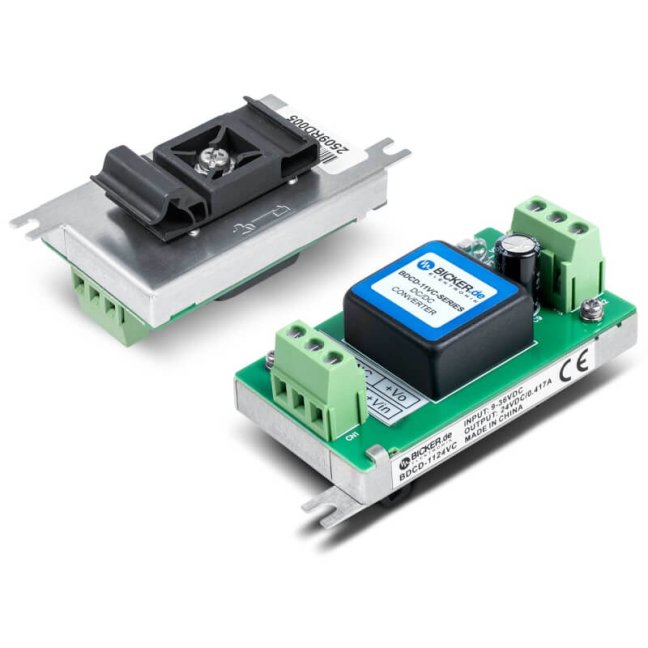
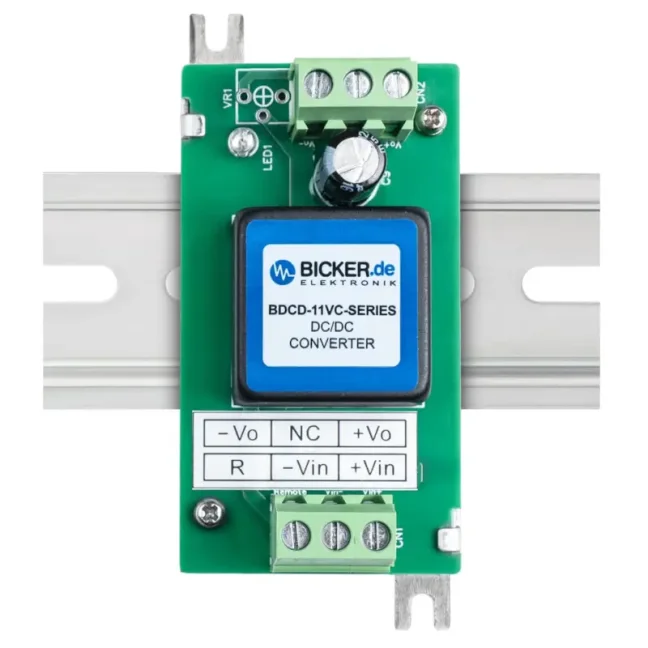
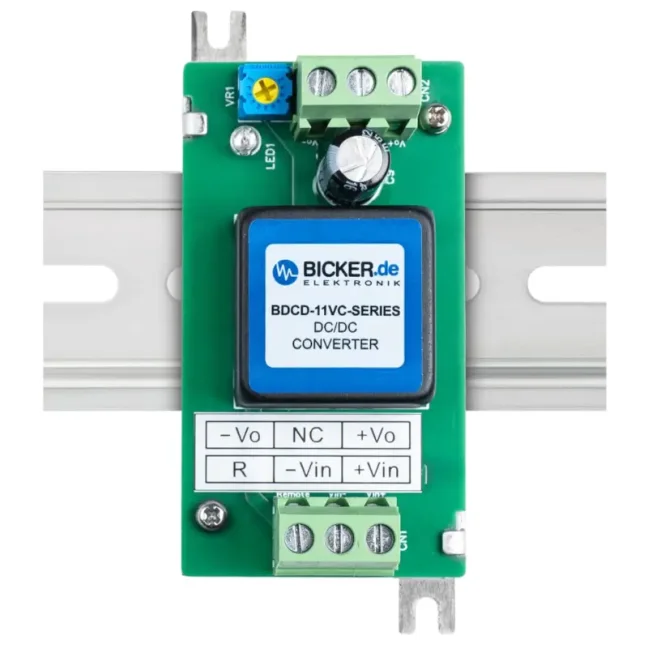
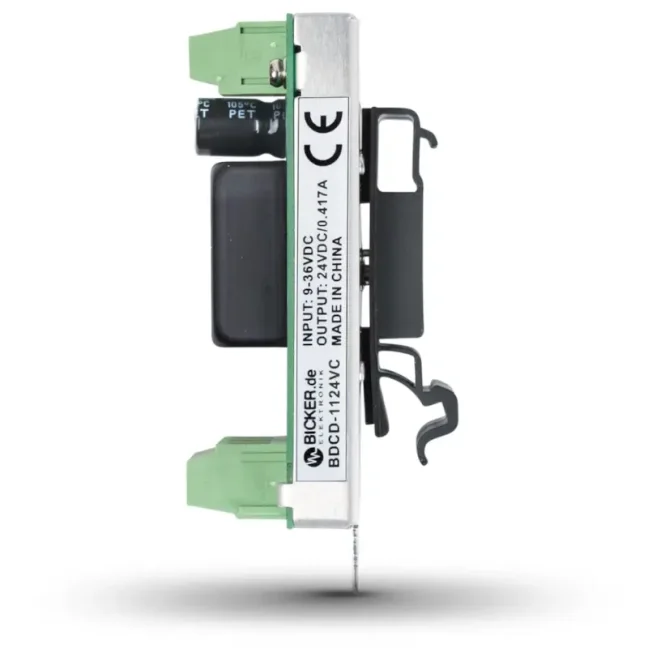


10 W DC/DC voltage converter Bicker (9–36 VDC → 5 / 12 / 24 VDC) - Type: 9–36 VDC ⟹ 24 VDC

The DC/DC voltage converter with a power rating of 10 W converts an input voltage of 9–36 VDC into a stable output of 5 V, 12 V or 24 VDC (depending on the variant). It ensures safe and stable power supply for sensitive electronics in industrial applications, reduces the impact of voltage fluctuations, and contributes to reliable long-term operation of the equipment. More
Code: BDCD-1124VC
Options 3
| Type | Code | Availability | Price excl. VAT | |
|---|---|---|---|---|
| 9–36 VDC ⟹ 24 VDC | BDCD-1124VC | In stock 2 pcs |
38 EUR
|
|
| 9–36 VDC ⟹ 12 VDC | BDCD-1112VC | In stock 2 pcs |
38 EUR
|
|
| 9–36 VDC ⟹ 5 VDC | BDCD-1105VC | In stock 2 pcs |
38 EUR
|
10 W DC/DC voltage converter Bicker (9–36 VDC → 5 / 12 / 24 VDC)
An isolated Bicker DC/DC voltage converter with an output power of 10 W is designed for converting DC voltage in industrial applications. It provides safe and stable power supply for devices that require a different voltage level than what is available in the system. The DC/DC converter is a suitable solution wherever it is necessary to create a different, stable voltage level from an available DC supply without the need for an additional power source.
The converter accepts an input voltage of 9–36 VDC and converts it to the required output level of 5 V, 12 V or 24 VDC (depending on the variant). This makes it possible to power PLC modules, sensors, communication devices, or other electronics from a single shared power source.
Why choose the Bicker BDCD-11VC DC/DC converter?
- Stabilizes voltage and protects sensitive electronics from power fluctuations
- Allows multiple devices to be powered from a single common DC power line
- Provides galvanic isolation between input and output (1500 VDC) – reducing noise transfer and ground loop formation
- Wide input range 9–36 VDC (4:1) enables use in various DC systems
- Remote on/off control allows controlled power supply of connected devices
- Compact industrial design with DIN rail mounting enables easy installation and replacement
- 10 W output power suitable for local supply of medium-consumption devices or several smaller devices simultaneously
- Designed for continuous 24/7 operation across a wide temperature range
- Suitable for installations at high altitudes (up to 5000 m)
Main features
- Input voltage: 9–36 VDC (4:1)
- Output voltage (depending on variant): 5 / 12 / 24 VDC
- Power: 10 W
- Efficiency: up to 88%
- Input/output galvanic isolation: 1500 VDC
- Short-circuit protection with automatic recovery
- Fully encapsulated aluminum housing
- DIN rail mounting
- Wide operating temperature range:
- BDCD-1112VC / BDCD-1124VC: -40 to +70 °C
- BDCD-1105VC: -40 to +105 °C
Typical applications
- Local power supply for communication modules, industrial routers and converters
- Powering PLC modules, sensors and other electronics from a shared DC supply (9–36 VDC)
- Stabilized and galvanically isolated power supply for single-board computers (SBC) and embedded devices
- Separate power branches for devices with medium power consumption
- Decentralized power points in control cabinets with limited space
- Applications requiring a simple, compact and galvanically isolated 10 W power supply
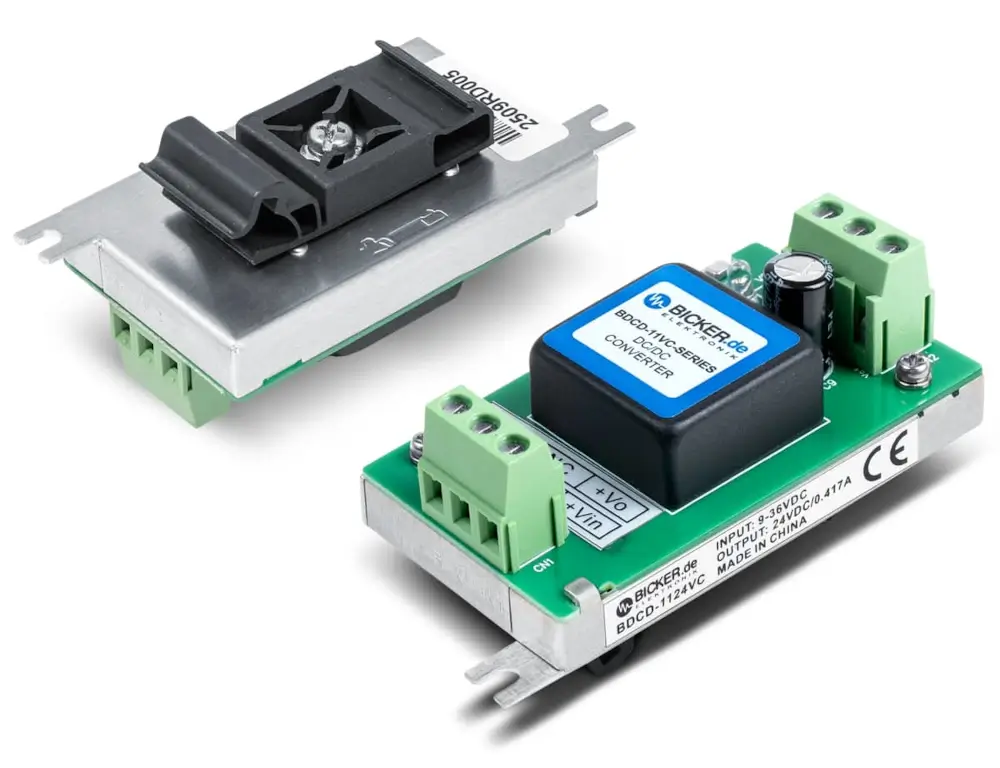
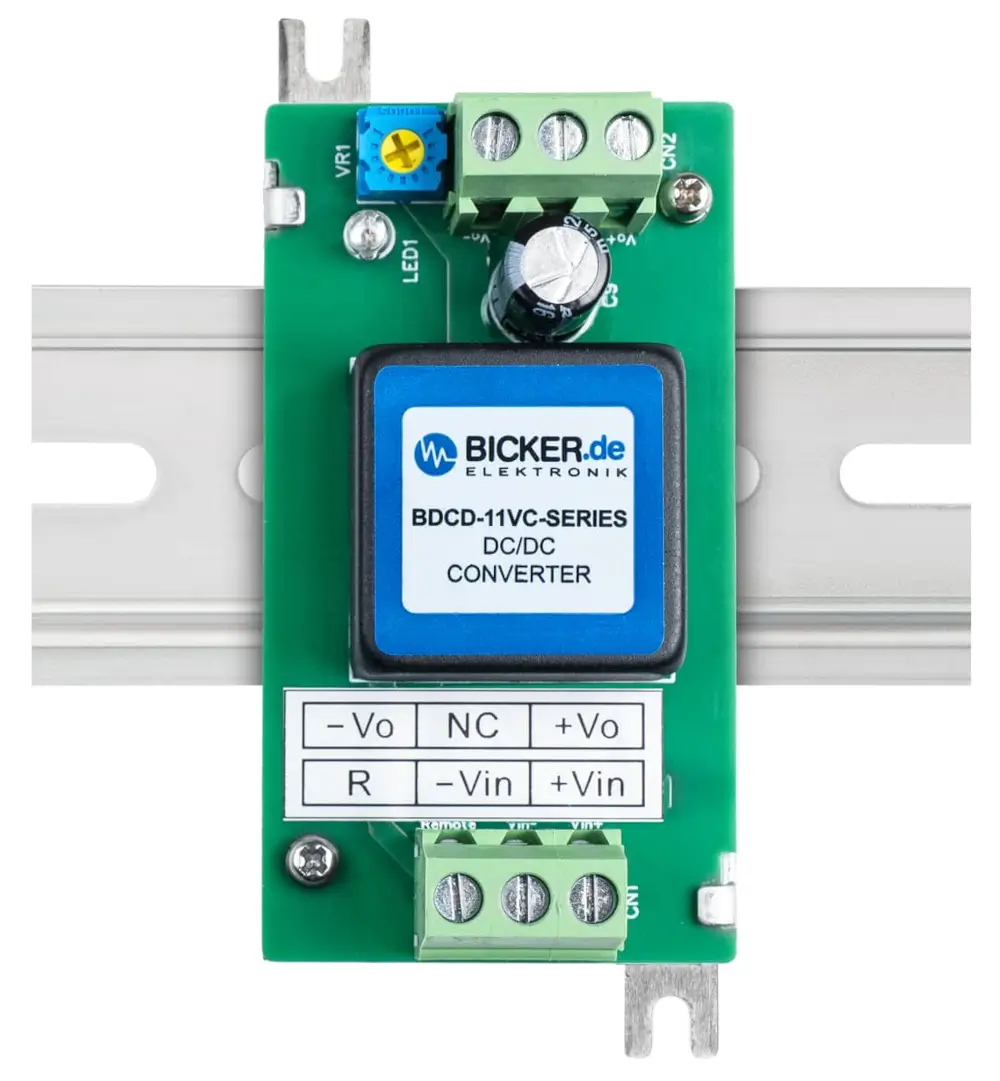
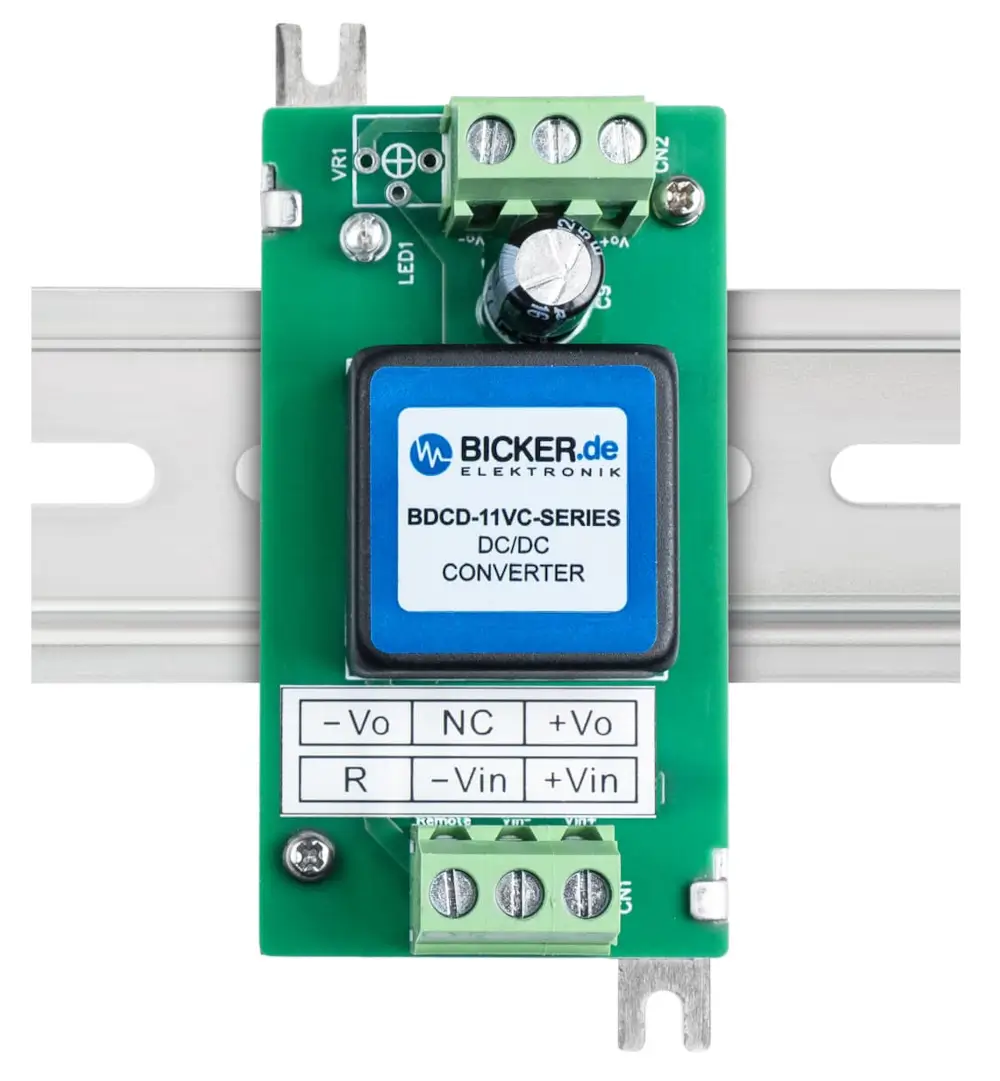
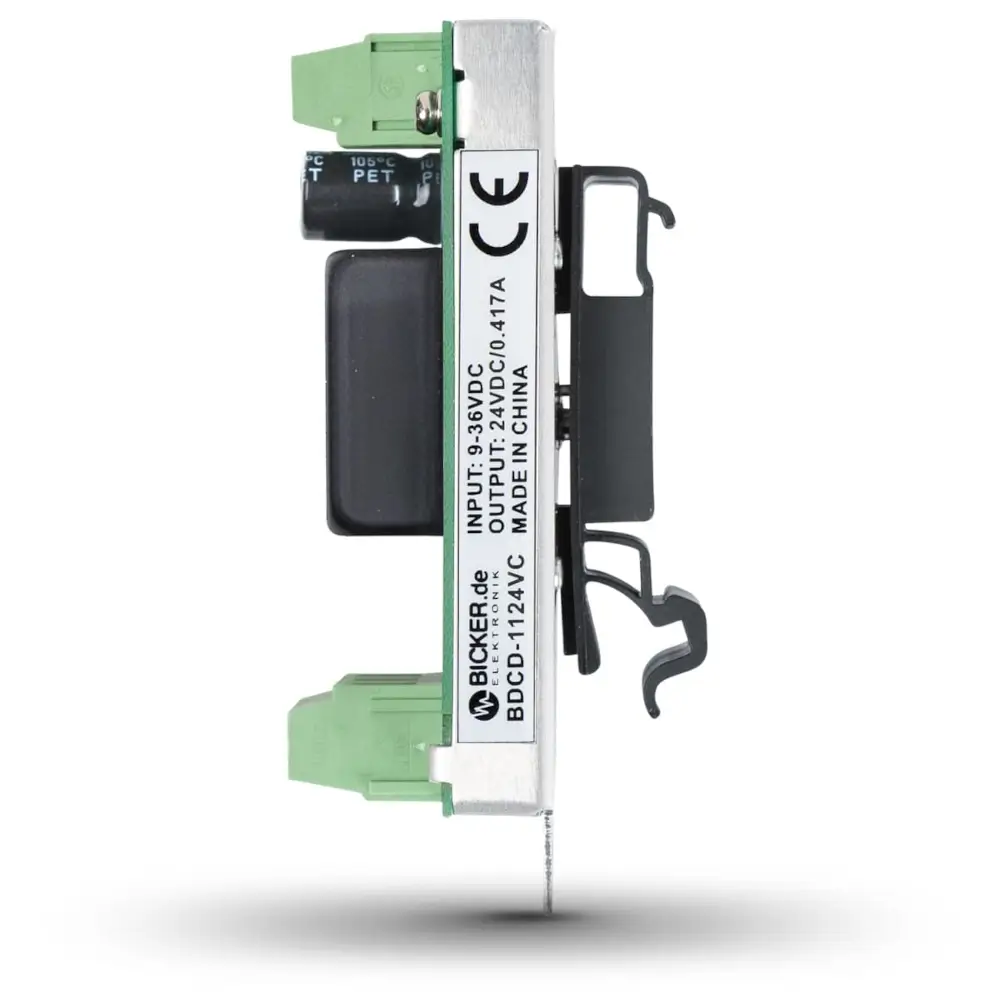
Basic Parameters of the BDCD-11VC Series
- Input voltage: 9–36 VDC (4:1)
- Power: 10 W
- Output voltage: depending on variant 5 V / 12 V / 24 VDC
- Galvanic isolation input/output: yes
- Isolation voltage: 1500 VDC
- Mounting: DIN rail
- Operation: suitable for continuous 24/7 operation
- Max. operating altitude: 5000 m
- Design: fully encapsulated aluminum enclosure
- Dimensions (W x D x H): 84.2 x 37.5 x 38.4 mm
- Remote ON/OFF:
- ON: 3.5–36 V or open input
- OFF: 0–1.2 V
Variants and Key Differences
| Model | Output voltage | Output current | Efficiency | Output adjustment (VR) | Temperature range |
|---|---|---|---|---|---|
| BDCD-1124VC | 24 VDC | 0–0.417 A | 88 % | no adjustment | -40 to +70 °C |
| BDCD-1112VC | 12 VDC | 0–0.833 A | 87 % | ±10 % | -40 to +70 °C |
| BDCD-1105VC | 5 VDC | 0–2 A | 83 % | ±10 % | -40 to +105 °C |
Frequently Asked Questions about Bicker BDCD-11VC DC/DC Converters
What is Bicker BDCD-11VC?
DIN rail DC/DC converters for converting 9–36 VDC to a stable output of 5 V / 12 V / 24 VDC (depending on the variant) with a power rating of 10 W.
Where is BDCD-11VC used?
For local power supply of communication and control modules or peripherals in a control cabinet when they require a regulated voltage of 5/12/24 VDC (depending on the variant), even if the input supply branch 9–36 VDC fluctuates, or when a galvanically isolated power branch is required.
Can the converter be used for parallel operation or battery charging?
The converter is not intended for parallel operation or for charging batteries. It is designed as a regulated power supply for electronic devices.
Why choose a DC/DC converter with galvanic isolation?
Galvanic isolation between input and output helps separate power branches with different potentials and reduces issues with ground loops and interference transfer between parts of the installation.
Which BDCD-11VC variant should I choose?
According to the required output voltage of the powered device: BDCD-1105VC (5 V), BDCD-1112VC (12 V), BDCD-1124VC (24 V).
Can the output voltage be adjusted (VR/trim)?
Yes, for the 5 V and 12 V variants fine adjustment of ±10% is available. The 24 V variant has a fixed output.
What temperature range does BDCD-11VC support?
The operating temperature range depends on the variant: typically -40 to +70 °C, while the 5 V variant supports up to -40 to +105 °C.
Storage temperature is -55 to +85 °C.
Does the converter support remote ON/OFF?
The converter features a dedicated Remote ON/OFF control input. To switch on, 3.5–36 V or an open circuit is required; to switch off, 0–1.2 V.
How is BDCD-11VC protected against input overvoltage?
The input includes protection against short overvoltage spikes. The converter can withstand 50 V for 100 ms, helping manage short voltage impulses in 24 V installations.
How is BDCD-11VC protected against output short circuit?
The converter includes short-circuit protection on the output. In the event of a short circuit, it limits the output to prevent damage and automatically returns to normal operation once the fault is removed (auto-recovery).
How is BDCD-11VC protected against low input voltage?
The converter includes undervoltage protection at 8.4 V. If the input voltage drops below this level, the converter prevents operation outside the permitted range, reducing the risk of output instability.
How is BDCD-11VC protected against output overload?
It includes overcurrent protection with a trigger threshold between 110–170% of nominal current. If this limit is exceeded, the protection activates to prevent continuous overload.
How is BDCD-11VC fused on the input?
The manufacturer specifies the requirement for an external fast 2 A fuse on the input, which must be added by the customer for line protection as part of the overall protection of the converter.
How is BDCD-11VC protected against reverse input polarity?
Reverse polarity protection is implemented using an input protection component (TVS/Zener) that creates a short circuit when the polarity is reversed. The external fast 6 A fuse installed by the user then melts, disconnecting the power supply and protecting the converter.
Up to what altitude can the converter operate?
The maximum operating altitude is 5000 m.
Highlighted items are mandatory.

Machine Data Collection, Archiving and Integration Package: Kepware Manufacturing Suite + Kepware Datalogger + OPC Router Standard
4 513,30 EUR Incl. VAT

Training on data collection and integration from machines using OPC, MQTT, and the Kepware KEPServerEX and OPC Router software, 2 days
1 076,90 EUR Incl. VAT

Training PROFINET – Basics, Diagnostics & Network Troubleshooting, 2 days
1 076,90 EUR Incl. VAT

Training PROFIBUS - Basics, Diagnostics & Network Troubleshooting, 2 days
1 076,90 EUR Incl. VAT
Diagnostics, troubleshooting and monitoring of PROFINET Networks
from 367,84 EUR Incl. VAT

Diagnostics, troubleshooting and monitoring of PROFIBUS networks
from 367,84 EUR Incl. VAT
Related products6
Machine Data Collection, Archiving and Integration Package: Kepware Manufacturing Suite + Kepware Datalogger + OPC Router Standard
4 513,30 EUR Incl. VAT
Training on data collection and integration from machines using OPC, MQTT, and the Kepware KEPServerEX and OPC Router software, 2 days
1 076,90 EUR Incl. VAT
Training PROFINET – Basics, Diagnostics & Network Troubleshooting, 2 days
1 076,90 EUR Incl. VAT
Training PROFIBUS - Basics, Diagnostics & Network Troubleshooting, 2 days
1 076,90 EUR Incl. VAT
Diagnostics, troubleshooting and monitoring of PROFINET Networks
from 367,84 EUR Incl. VAT
Diagnostics, troubleshooting and monitoring of PROFIBUS networks
from 367,84 EUR Incl. VAT