

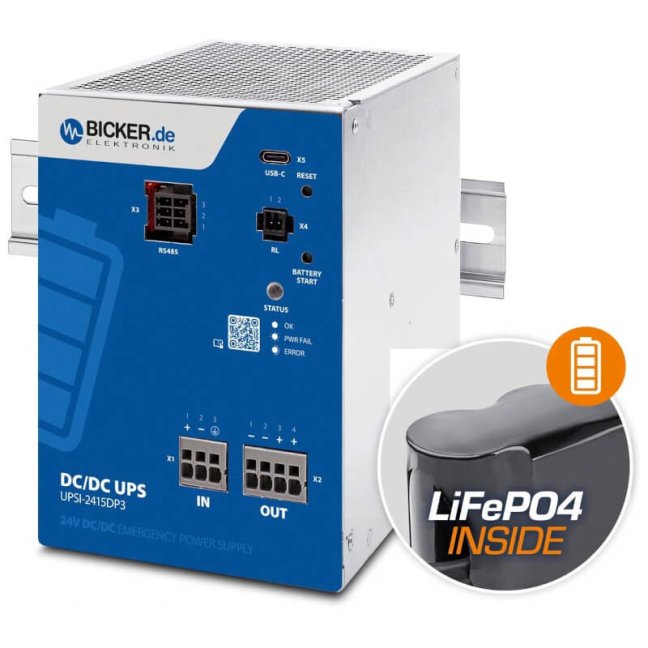


360 W 24 VDC / 15 A UPS backup power supply Bicker with LiFePO4 battery and USB-C + RS485 Modbus interfaces

Smart industrial DC UPS 24 VDC / 15 A, 360 W, integrated 64 Wh LiFePO4 battery, configuration via UPScom software, USB-C and RS485 Modbus interface, DIN rail mounting. More
Code: UPSI-2415DP3
Smart industrial DC UPS 24 VDC / 15 A, 360 W, integrated 64 Wh LiFePO4 battery, configuration via UPScom software, USB-C and RS485 Modbus interface, DIN rail mounting. More
Code: UPSI-2415DP3
Bicker UPSI-2415DP3 · backup power supply with battery
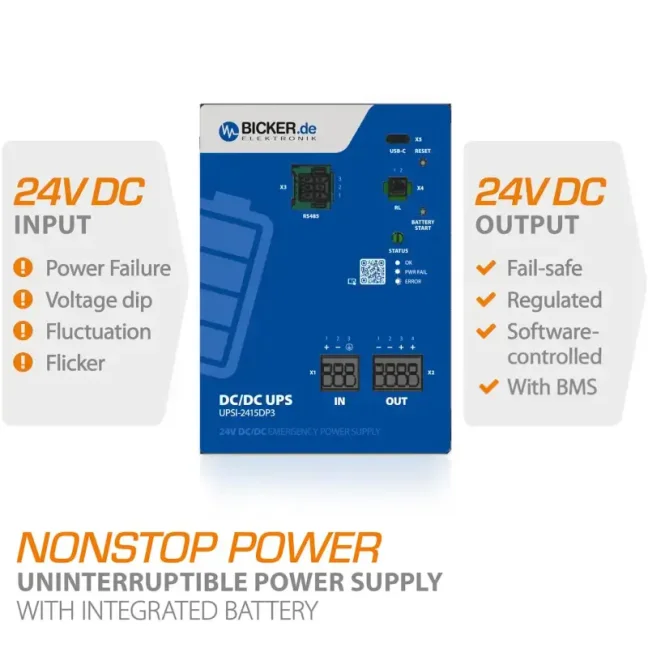
Protect your 24V devices and data from power outages
Bicker UPSI-2415DP3 is a backup power supply with a built-in battery for devices powered by 24 V direct current. During a power outage, it temporarily supplies them from the battery so they can keep working or safely save data and shut down. It provides 360 W of power, up to 15 A of current and a 64 Wh LiFePO₄ battery. It mounts on a DIN rail, the standard mounting rail used in control cabinets. FOXON helps you choose the right solution and ships worldwide.

How long do you need to keep your devices running during an outage?
Tell us which devices you want to back up and for how long. If you know their power consumption in watts, include it; we will help you choose a suitable backup unit and power supply.
Reliable backup for industrial automation
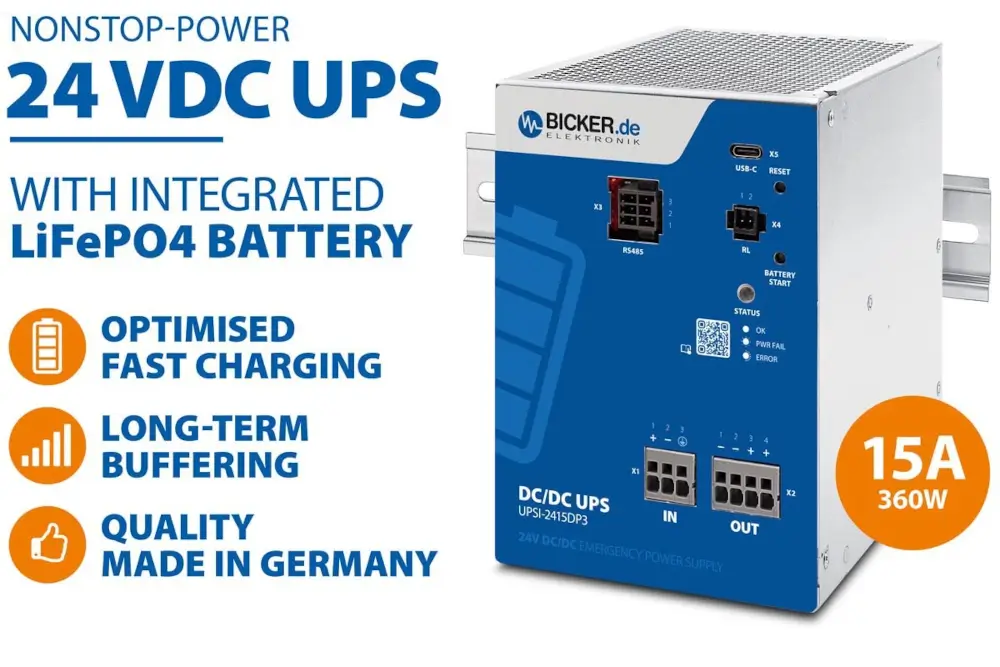
An uninterruptible power supply, or UPS, helps keep industrial computers, machine controllers (PLCs), network devices and measuring instruments running during power outages or voltage fluctuations. It switches to the battery in less than 3 ms, or three thousandths of a second. On battery power, it maintains an output voltage of 24.5 VDC ±2 %. When choosing the unit, check the required backup time and make sure your devices can tolerate this brief transfer time.
Supplies connected 24V devices with up to 15 A. On battery power, it maintains 24.5 VDC ±2 %.
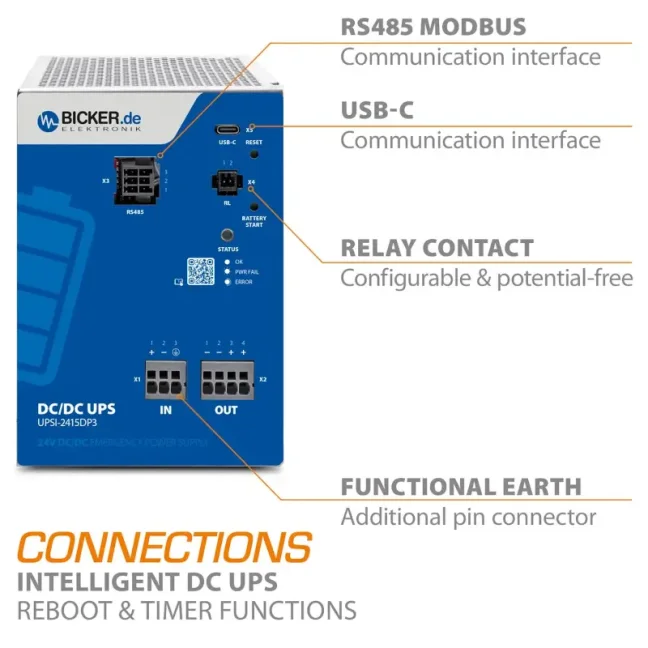
USB-C connects the unit to a computer. RS485 Modbus RTU can send data to a machine controller or monitoring system. A relay contact can also signal a power failure.
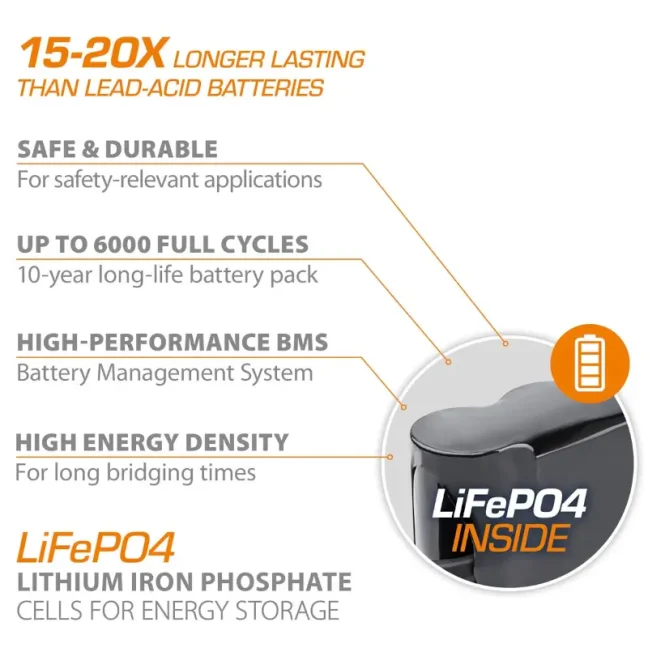
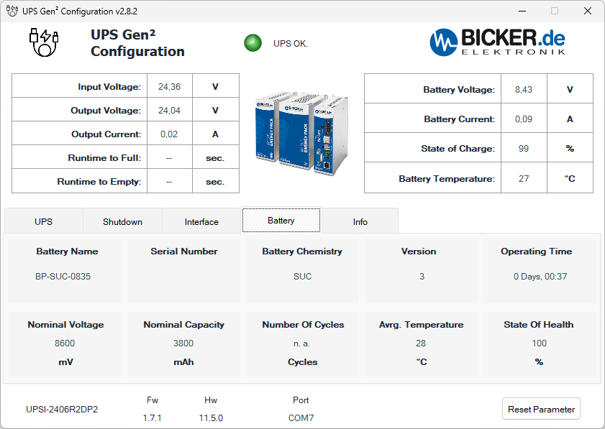
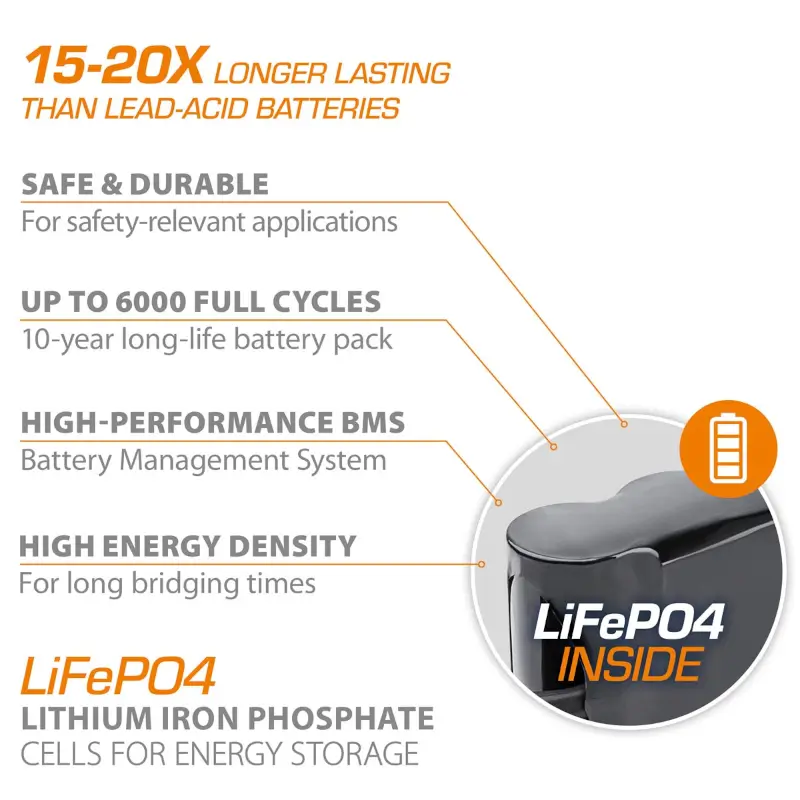
The built-in LiFePO₄ battery has a capacity of 64 Wh and supports up to 6 000 charge and discharge cycles. Protective electronics continuously monitor its condition.
For new control cabinets and upgrades to existing equipment
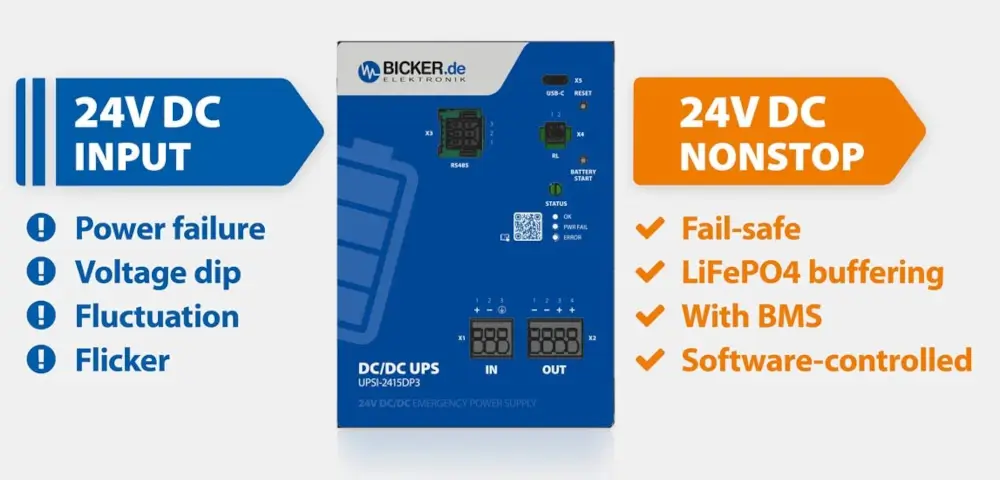
Use the UPSI-2415DP3 when building a new control cabinet or adding backup power to an existing machine. It helps protect devices powered by 24 V against short outages and voltage fluctuations.
A machine controller, industrial computer or PROFINET or Ethernet network switch can therefore keep running until power returns or the machine stops safely. DIN rail mounting makes installation in a control cabinet straightforward.

LiFePO₄: safe energy for years of operation
LiFePO₄ stands for lithium iron phosphate battery technology. This type of battery features stable cells and a long service life: the manufacturer specifies up to 10 years and up to 6 000 full charge and discharge cycles. An electronic battery management system (BMS) monitors charging and discharging and protects the battery if a fault occurs.
The battery withstands repeated charging and discharging well, helping reduce the need for replacement. Its actual service life depends on temperature, the power drawn by connected devices and how deeply it is discharged. Recharge it as soon as possible after discharge; prolonged storage in a discharged state can damage it.
How long can your devices run on the battery?
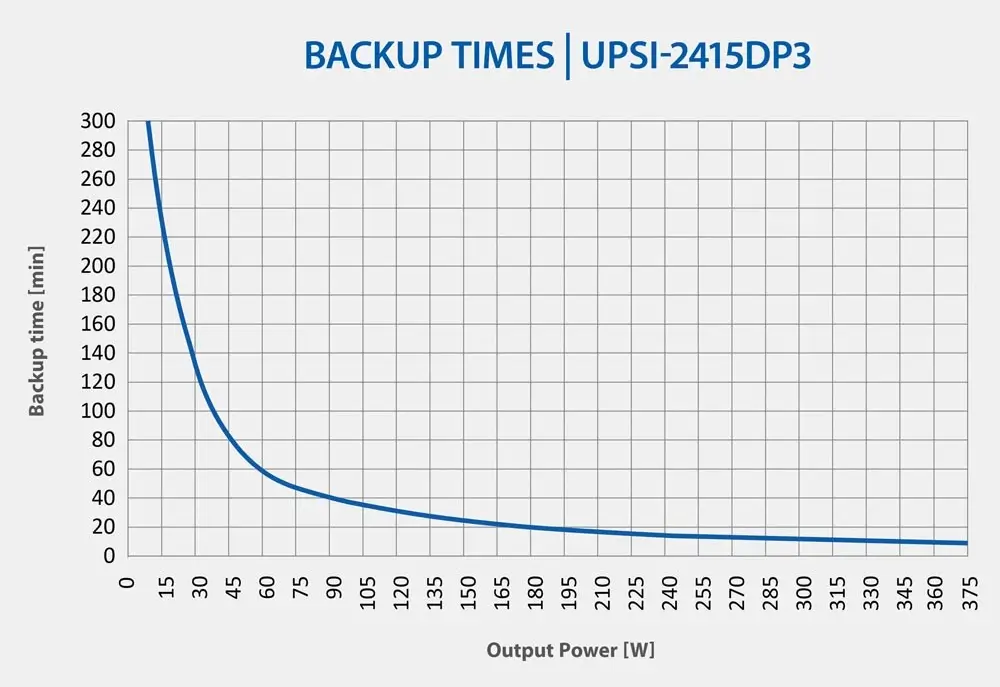
The manufacturer's curve shows backup time against output power at +25 °C. For the UPSI-2415DP3, the manual specifies 8 min 10 s at the rated output current of 15 A. Lower power consumption extends this time; the actual result depends on battery condition and charge, temperature and UPS settings. When selecting the unit, add up the power consumption of all the devices you want to back up.
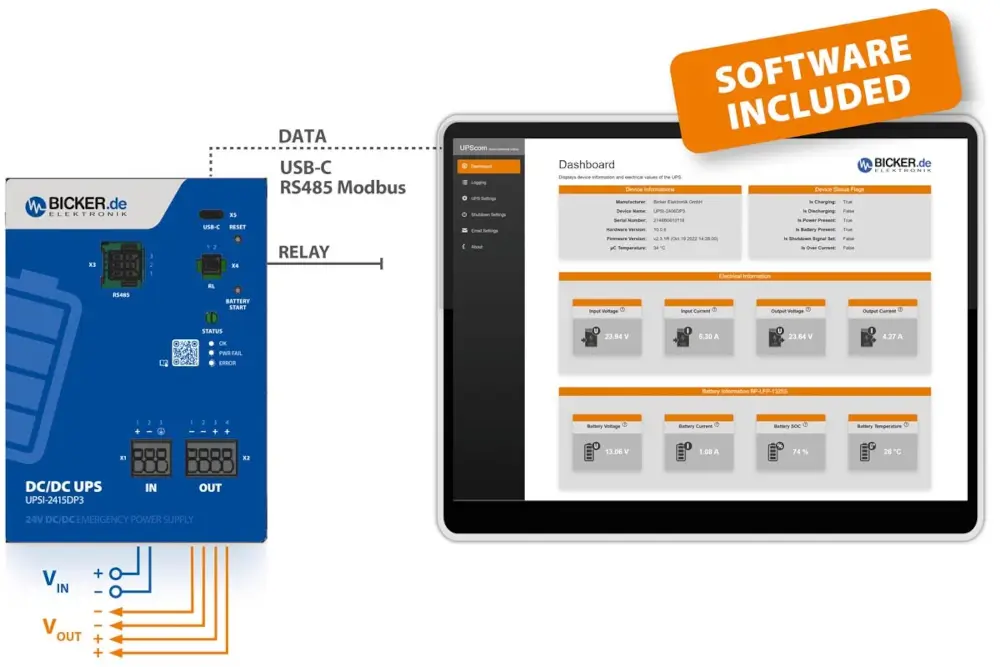
View battery status and settings in your browser
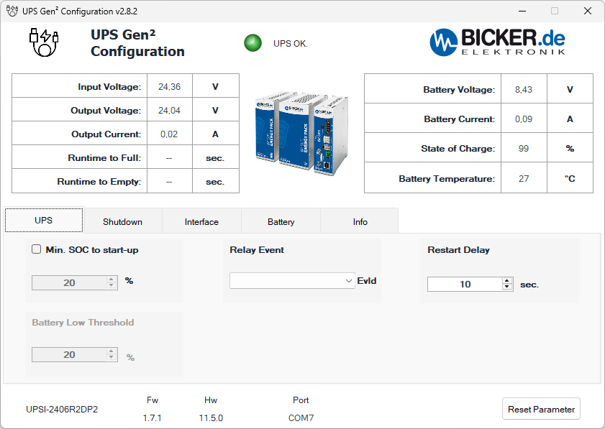
UPScom shows the current battery status and lets you set how the backup unit should respond to an outage. The program is installed on your computer and controlled through a web browser. Versions are available for Windows and Linux.
When connected via USB-C, supported operating systems recognise the device as a UPS without an additional driver. The technical name for this feature is HID Power Class. UPS Gen2 Configuration Software lets you change internal settings and update the firmware — the unit's internal control software — in Windows. Use UPScom for continuous monitoring, email alerts or running your own program before the computer shuts down.
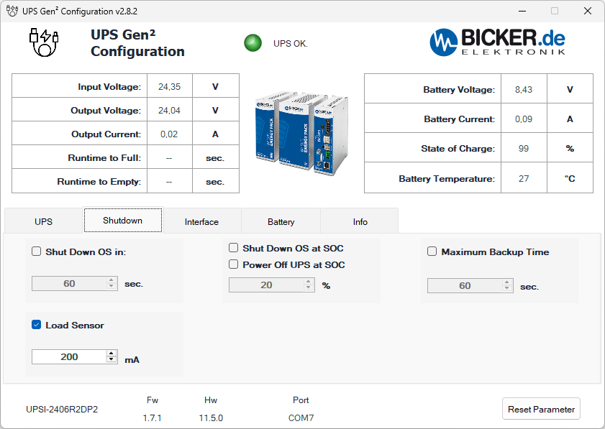
- monitoring current draw in mA and detecting when it drops below a set threshold,
- shutdown delay, maximum backup time and minimum charge before startup,
- email notifications in case of loss of connection, power outage or system shutdown,
- safe shutdown and, if needed, running a custom script — a prepared sequence of commands — before the computer switches off.
Safe shutdown and automatic computer restart
During a power failure, the UPS alerts the connected computer. With the correct settings, the computer can save data, complete prepared tasks and shut down safely. When power returns, you can use the automatic restart function, called Reboot by the manufacturer. To ensure everything works as expected, also check the operating system settings and the automatic power-on settings of the industrial computer (IPC).
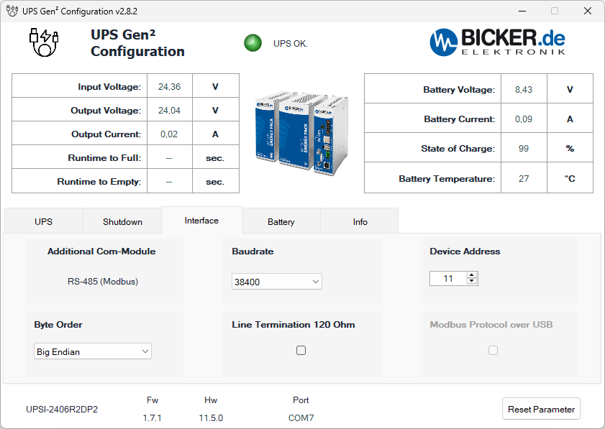
USB-C is mainly used for connecting to a computer. The RS485 interface with Modbus RTU allows a machine controller (PLC) or monitoring system (SCADA) to read the UPS status and work with its settings.
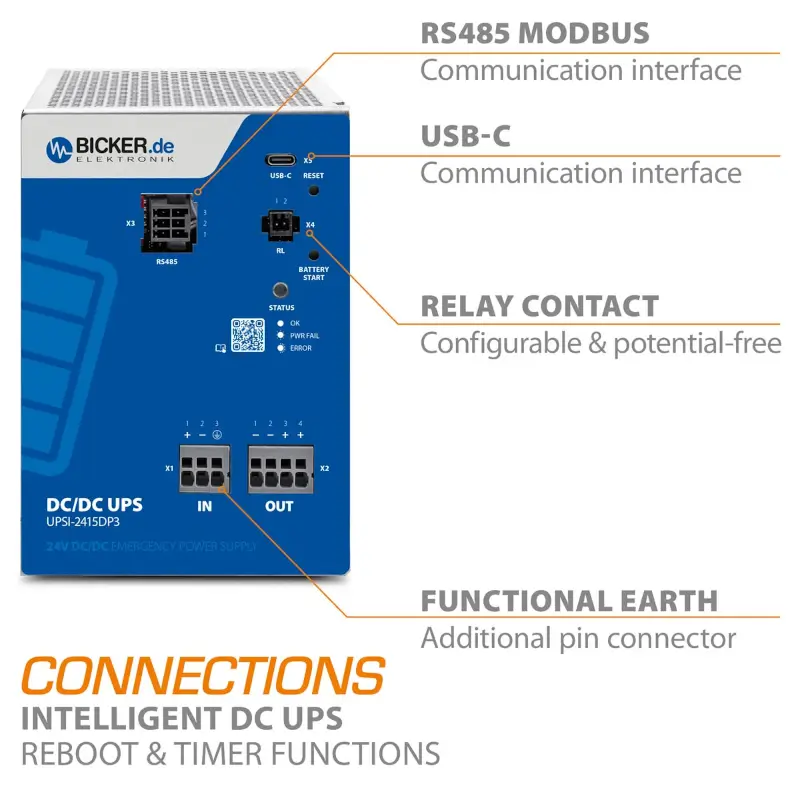
Connections for computers, machines and power failure signalling
Practical features that help in real operation
The UPSI-2415DP3 monitors the power drawn by connected devices and the condition of the battery. Depending on its settings, it can give them time to finish their work or shut down safely during an outage.
The manual specifies a charging time of 28 min at maximum charging current. If the UPS is also supplying connected devices, charging takes longer: the indicative curve shows approximately 30 min with no output load and 125 min at 15 A. Charging time is therefore not fixed across all operating conditions.
Shutdown can be set according to the remaining battery charge, the maximum permitted backup time, a schedule or a drop in power draw. The connected computer or machine controller can first save its data and finish work safely. Only then does the UPS disconnect the power.
Allow natural airflow around the UPS and observe the installation clearances. Operation below 0 °C reduces battery performance; the manufacturer recommends not exceeding 3.5 A in backup mode. Observe the manual's temperature derating curve at higher temperatures too — the full 15 A is not available throughout the −20 to +50 °C range.
Immunity and protection functions
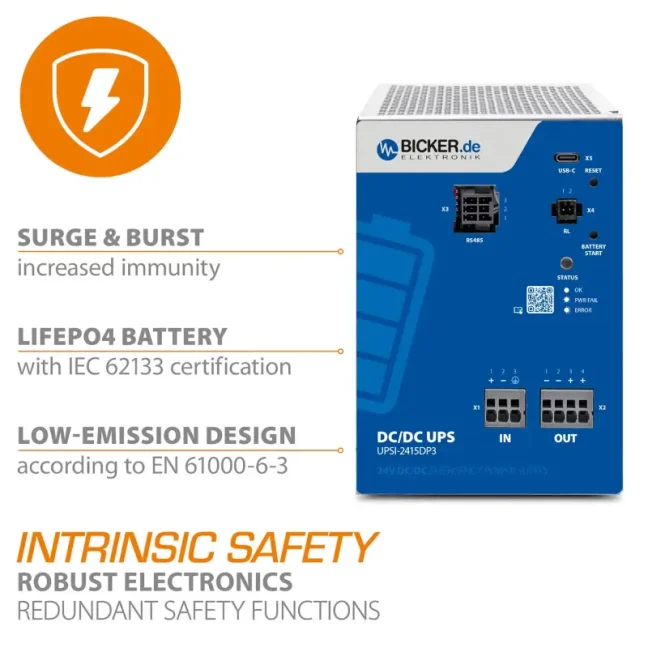
The UPSI-2415DP3 operates at −20 to +50 °C with temperature-dependent current derating. The manual lists UL 61010-1 / UL 61010-2-201, CSA C22.2 61010-1-12 / CSA C22.2 61010-2-201 and CB Scheme IEC 61010-1 / IEC 61010-2-201 certifications. The battery pack has IEC 62133 safety certification. Its IP20 rating requires a suitable protective enclosure; it is not a safety control device.
Higher surge immunity helps keep the UPS running even when brief electrical interference pulses or sudden voltage surges occur on the power supply line.
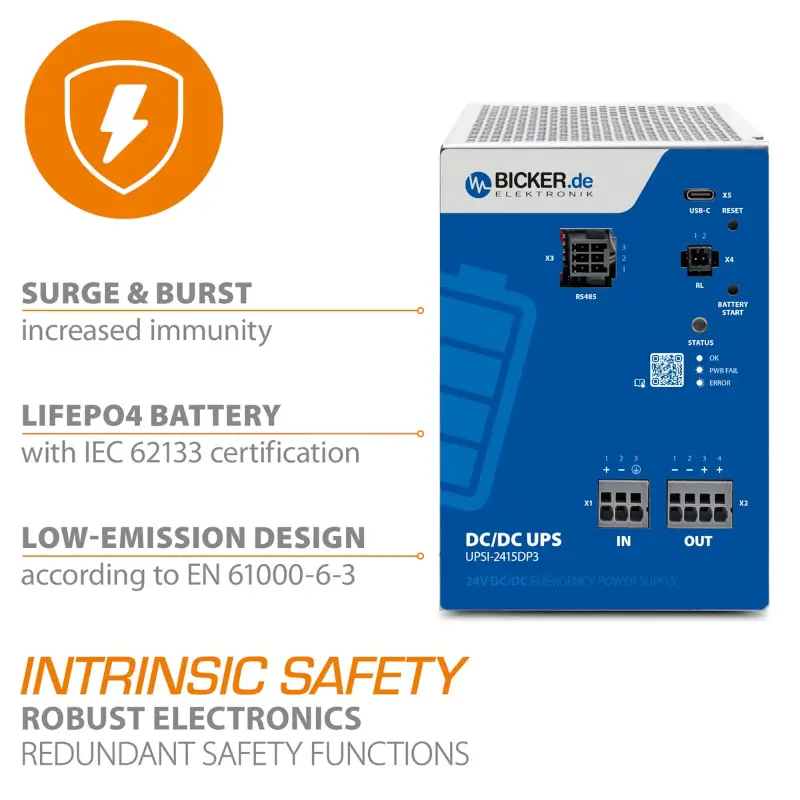
Immunity to short sequences of fast electrical interference pulses according to EN 61000-4-4: 2 kV. Surge immunity according to EN 61000-4-5: ±1 kV between L–N conductors and ±2 kV between L–PE/N–PE. Both tests meet criterion A: the device must operate within the specified limits during testing without affecting the output voltage. Interference generated by the unit itself meets EN 61000-6-3 limits.
Protection against reverse polarity, overcurrent, short circuits and input backfeed. The UPS and BMS monitor temperature and battery condition; charging may pause after high-temperature operation until the battery cools down.
The UPS lets you set how long to supply power after an outage and detect low power draw from connected devices. It protects the battery from excessive discharge by automatically disconnecting the output. It also allows manual startup from a charged battery without an input power supply.
Technical parameters
| Manufacturer's order code | UPSI-2415DP3 |
|---|---|
| Input voltage | 24 VDC, range 23–30 VDC |
| Output | Rated at 24 VDC. During normal operation, the output follows the input voltage with a drop of no more than 0.7 V, depending on current draw. On battery power, it maintains 24.5 VDC ±2 %. |
| Output current / power | Rated current of 15 A in both modes. Rated output power is 360 W during normal operation and 367.5 W at 24.5 V on battery power. The manufacturer's power figures apply without simultaneous battery charging. |
| Output current at increased load (I_STAT.BOOST) | 15.2 A during normal operation and on battery power; the protective shutdown limits below apply. |
| Power at increased load (P_STAT.BOOST) | 365 W during normal operation; 372.4 W on battery power. Figures apply at I_STAT.BOOST current and without simultaneous battery charging; they do not represent a new rated power for the device. |
| Brief output current pulse (I_SFB) | 90 A for 5 ms in both modes. This is a brief pulse, not a continuously available current. |
| Capacitance connected to the output at startup | 10 000 µF at startup if the output is not simultaneously supplying current to connected devices (0 A); specified for normal operation. |
| Output short-circuit protection | Yes, during normal operation and on battery power. The manufacturer specifies reversible short-circuit protection for normal operation. |
| Operation with no output load | Yes, the unit can operate with no current drawn from the output in both modes. |
| Protective shutdown if current is too high | Current of 15.2–16.8 A: no more than 100 ms before shutdown. Current above 16.8 A: no more than 5 ms before shutdown. Applies during normal operation and on battery power. |
| Internal output fuse | 15 A; specified in the manufacturer's normal-operation data. |
| Battery | LiFePO₄, 2.5 Ah / 64 Wh; built-in electronic battery management and protection (BMS) |
| Switching time | < 3 ms |
| Communication / signalling | USB-C (USB 2.0; HID for UPS recognition, VCOM for a virtual serial port), RS485 Modbus RTU; potential-free relay contact for power failure signalling |
| Mounting and degree of protection | DIN rail EN 60715, IP20 |
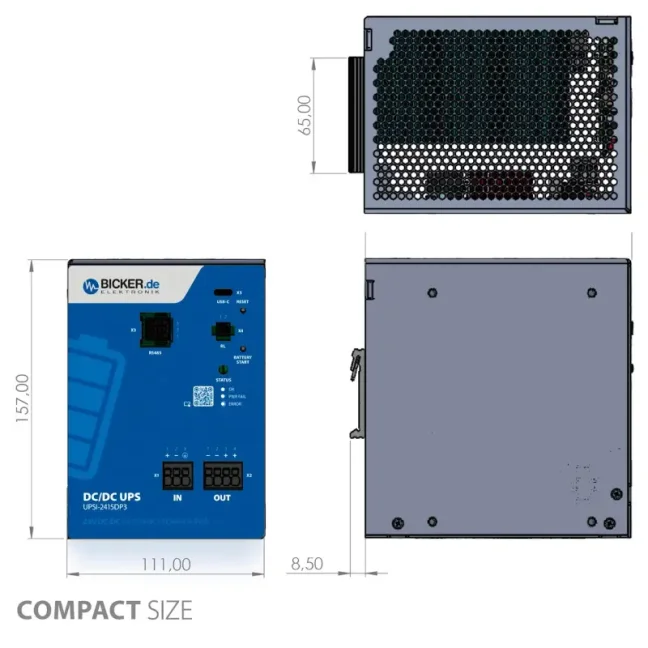
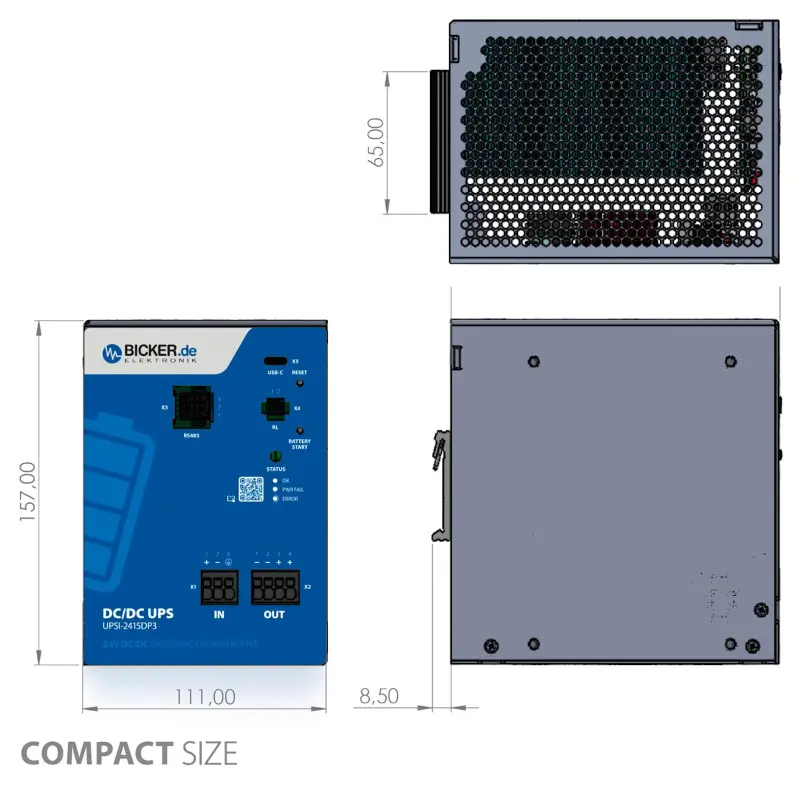
| Dimensions (W × H × D) | 111 × 157 × 150 mm; excluding front connectors and DIN rail bracket |
| Weight | 1.43 kg (UPS unit) |
| Operating conditions | −20 to +50 °C with temperature-dependent current derating; max. 95 % relative humidity at +25 °C without condensation; up to 4 000 m |
| Maximum input current | 17.5 A |
| Backup at rated current | 8 min 10 s at 15 A; reference conditions +25 °C |
| Charging | 28 min at maximum charging current; longer under load (see curve in the manual) |
| Relay contact | 24 VDC / 0.5 A max.; signalling by closing or opening the contact (NO/NC) can be configured in software; for reporting operating status only |
| RS485 Modbus RTU | 38 400 Bd; cable length <100 m; the interface is not electrically isolated from the UPS circuits (no galvanic isolation) |
| Storage / transport | −30 to +55 °C; recommended storage state of charge 80 % |
| Power supply connected upstream of the UPS | SELV/PELV protective extra-low voltage power supply, min. 24 V / 20 A for full functionality; 500 W recommended |
| Connecting multiple UPS units | Series and parallel connection are not permitted |
Technical data: Bicker UPSI-2415DPx manual, revision 1-1 dated 26 May 2026, particularly chapters D1 and E. Reference measurement conditions: +25 °C, 24 VDC input and rated current, unless stated otherwise. Open the manufacturer's manual (PDF) ↗
Scope of delivery
- 1× UPSI-2415DP3 backup power supply with built-in LiFePO₄ battery
- 1× RS485 (Modbus) mating connector
- 1× relay mating connector
Contents according to chapter E7 of the manual. Select the power supply and connection cables separately to suit your devices; we will be happy to help.

About the manufacturer
Bicker Elektronik
Bicker Elektronik is a German manufacturer that has been developing, manufacturing and supplying industrial power supplies, UPS backup systems and system components since 1994.
Bicker products are used in automated machines, robots, measuring instruments, production data collection equipment, medical equipment and communication systems, among other applications. For the UPSI-2415DP3, the manufacturer focuses on long-term operation in control cabinets, connections to other equipment and backup power for important devices.
Frequently Asked Questions
How long can the UPSI-2415DP3 keep a device running during an outage?
The manual specifies 8 min 10 s at the rated current of 15 A under reference conditions of +25 °C. The battery has 64 Wh; backup time depends on power draw, charge, age, temperature and settings. Send us the total power consumption of the devices you want to back up and the required operating time during an outage — we will help you choose.
Can a machine controller monitor the UPS status?
Yes. RS485 Modbus RTU can send information to a machine controller (PLC) or monitoring system (SCADA). USB-C also connects the unit to an industrial computer, where a supported operating system recognises it as a UPS (HID-UPS).
Can devices start from the battery without an external power supply?
With the battery charged, hold the BS button for more than 2 s and no longer than 5 s to start the output without input power. Pressing it again can switch the output off in this mode. Follow chapter E12 of the manual.
What happens when current draw is low or the battery discharges?
The UPS detects when current draw drops below a set threshold. Once the connected devices have shut down safely, it can disconnect their power. It also protects the battery from excessive discharge.
Should you choose a UPS with a battery or a supercapacitor?
A LiFePO₄ battery is suitable for longer operation during an outage. A supercapacitor is a different way of storing electrical energy: it is mainly suited to short, very frequent outages. The main factor when choosing is how long your devices need to work without the main power supply.
Can I use 15 A at −20 °C?
No. Temperature limits both available current and backup time. Chapter E15 recommends not exceeding 3.5 A during battery operation below 0 °C. The temperature derating curve also applies; do not automatically assume that 15 A is available at the upper temperature limit either.
Is the relay intended for safety circuits?
No. The potential-free contact is for operational signalling, rated at 24 VDC / 0.5 A maximum. The manufacturer explicitly prohibits using this contact to implement safety-critical circuits.
Do you ship UPS units outside the Czech Republic?
Yes, we ship products worldwide. Tell us the quantity, country and delivery location. We will check availability and provide a specific shipping quotation and delivery estimate.
Why buy from FOXON
Want to protect your devices from power outages?
Tell us what you want to back up, for how long and where we should deliver the unit. If you know your devices' power consumption and the required connection to a computer or machine, include those details. We will help you choose and prepare a quotation including shipping. We ship worldwide.
Request a solutionSchedule an online meeting
Need help with backup time, wiring or connecting the unit to your devices? Choose a time for a short online consultation directly in the calendar below.
Technical parameters
Basic features
- Device type: intelligent DC UPS module for 24 V systems
- Input voltage: 24 VDC (range 23–30 V)
- Output voltage: normal mode ≈ VIN − 0.6 V / backup mode 24.5 VDC regulated
- Output current: 15 A nominal
- Power: 360 W
- Battery technology: LiFePO4
- Mounting: on DIN rail according to EN 60715
Backup and battery
- Battery capacity: 2.5 Ah / 64 Wh
- Battery lifetime: up to 6000 charge and discharge cycles
- Battery management system (BMS): integrated
- Charging method: CC / CV / CP
Output and power
- Switching time: <3 ms
- Capacitive load: max. 10,000 µF (during start-up, load 0 A)
Input parameters and power supply
- Max. input current: 17.5 A
Communication and signalling
- Communication interfaces: USB-C (HID-UPS), RS-485 (Modbus RTU)
- Signalling: potential-free relay contact for Power Fail
Functions and protections
- Functions: intelligent input power control (Power Sharing), minimum load detection, timer on power failure, controlled system shutdown, automatic device restart, battery charge status indication, option to start the device from battery (Battery Start)
- Protections: protection against input polarity reversal, overcurrent, short circuit and overheating
Operating conditions
- Operating temperature: −20 to +50 °C
- Storage temperature: −30 to +55 °C
- Max. humidity: ≤95%, non-condensing
- Max. altitude: 4000 m
Mechanical design
- Protection rating: IP20
- Dimensions (W x H x D): 111 x 157 x 150 mm
- Weight: 1.43 kg
Frequently Asked Questions about the Bicker UPSI-2415DP3 DC UPS with LiFePO4 Battery
What is the UPSI-2415DP3?
The UPSI-2415DP3 is an intelligent DC UPS module for 24 V industrial systems with an integrated LiFePO4 battery (64 Wh), designed to ensure uninterrupted power supply during outages or voltage fluctuations.
How does a DC UPS work in an industrial system?
The UPS is installed between the power supply and the protected device. In normal operation, it passes the input voltage to the output while simultaneously charging the battery. In the event of a power failure, it automatically switches to backup mode and supplies the load from the battery.
What is the difference between the UPSI-2415DP3 and UPSI-2415DP2?
The UPSI-2415DP3 uses a LiFePO4 battery with a capacity of 64 Wh, enabling longer backup time. The UPSI-2415DP2 variant uses supercapacitors with an extremely long lifetime (up to 500,000 cycles), but with a shorter backup duration.
What is the output voltage during a power failure?
In backup mode, the UPS provides a regulated output voltage of 24.5 VDC, ensuring stable power even during battery discharge.
How long can the UPS power the device?
The backup time depends on the load. At full load (15 A), the typical backup time is approximately 8 minutes (approx. 8 min 10 s at nominal load). At lower loads, the runtime can be significantly longer.
What is the battery capacity and type?
The UPS contains an integrated LiFePO4 battery with a capacity of 2.5 Ah (64 Wh), known for high safety and long service life.
What is the battery lifetime?
The LiFePO4 battery can reach up to 6,000 charge cycles depending on operating conditions.
How fast does the UPS switch during a power failure?
The transition from normal to backup mode is very fast, typically within 3 ms, so connected devices usually do not notice the interruption.
How long does charging take?
A full battery charge takes approximately 28 minutes (from fully discharged state under standard conditions).
How can the UPS be monitored or configured?
The UPS can be connected via USB-C (HID-UPS) or via RS-485 using the Modbus RTU protocol. For advanced configuration and monitoring, UPS Gen2 Configuration or UPScom software can be used.
What does HID-UPS mode mean?
In HID-UPS mode, the device is recognized by the operating system as a standard UPS without the need for driver installation. This enables automatic power management and safe system shutdown.
How does the UPS signal a power failure?
The UPS signals its status via a potential-free relay contact (power fail) and diagnostics available through communication interfaces.
What is the Power Sharing function?
Power Sharing ensures intelligent distribution of input power between the load and battery charging, eliminating the need to oversize the power supply.
What does minimum load detection mean?
The UPS can detect when the load drops below a defined level and automatically switch off the output, for example after a proper system shutdown.
What is the Battery Start function?
Battery Start allows the UPS output to be activated directly from the battery even without input power (provided the battery is sufficiently charged).
What is the Power-fail timer?
The Power-fail timer allows setting a time interval after which the UPS initiates a controlled shutdown of connected devices during a power failure.
What happens when the battery is fully discharged?
The UPS protects the battery against deep discharge. Once the minimum level or maximum backup time is reached, the output is automatically disconnected to protect the battery.
How does the UPS behave at low temperatures?
At low temperatures, the available battery capacity and performance may decrease. At very low temperatures, it is recommended to limit the output current (e.g., approx. 3.5 A at −20 °C).
What applications is the UPSI-2415DP3 suitable for?
The UPS is suitable for industrial PCs (IPC), PLC systems, communication devices, IIoT gateways, SCADA systems, and other applications where power continuity and data protection are critical.
Bicker Review: Jarda Blažek compared 2 smart UPS units with a supercapacitor and a battery
Smart industrial backup power supplies from Bicker protect your production systems and industrial PCs against unexpected power outages, voltage drops, and fluctuations. Jarda Blažek (blaja.cz) investigated the practical differences between UPS units with an integrated supercapacitor and those with a LiFePO4 battery.
Highlighted items are mandatory.