



240 W 24 VDC / 10 A UPS backup power supply Bicker, LiFePO4 battery

Smart Industrial DC UPS Backup Power Supply 24 VDC / 10 A, 240 W, Integrated LiFePO4 Battery, configuration via UPScom software, DIN Rail Design More
Code: UPSI-2412DP3
Smart Industrial DC UPS Backup Power Supply 24 VDC / 10 A, 240 W, Integrated LiFePO4 Battery, configuration via UPScom software, DIN Rail Design More
Code: UPSI-2412DP3
Bicker UPSI-2412DP3 · UPS with LiFePO₄ battery
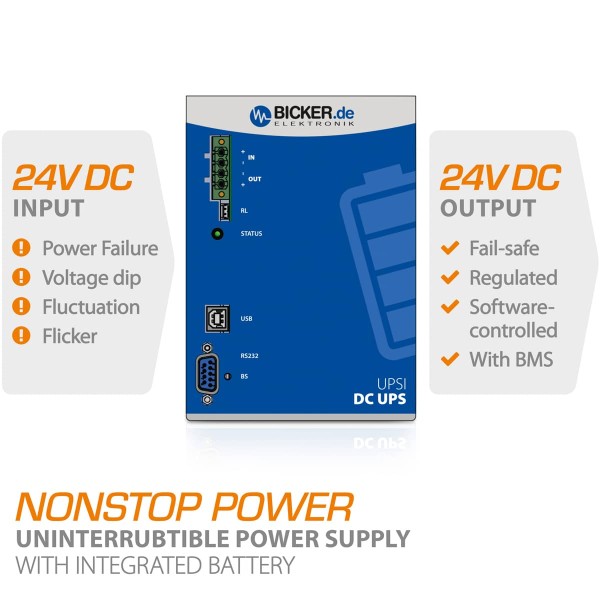
Protect your 24V devices and data from power outages
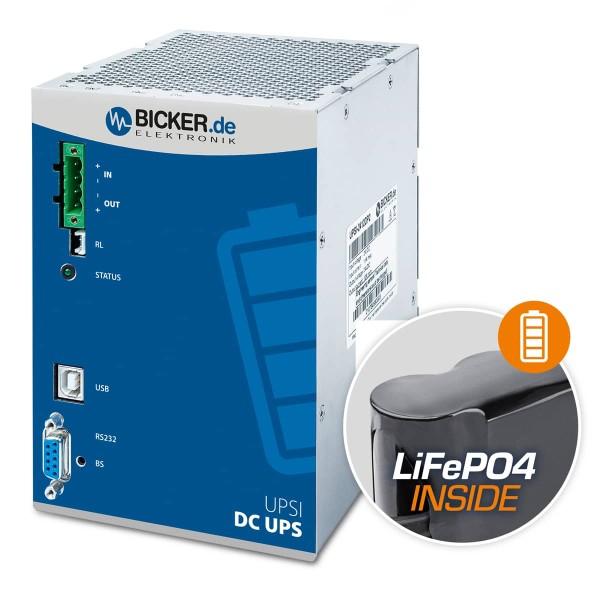
Bicker UPSI-2412DP3 helps keep your 24V devices running during a power outage, giving them time to save data or shut down safely. This 240 W class UPS supplies a rated current of 10 A and has an integrated 64 Wh LiFePO₄ battery. At a load of 10 A, it provides approximately 14 minutes 30 seconds of backup. It mounts on a DIN rail and communicates with a computer via USB or RS232. FOXON will help you choose the right solution and arrange worldwide shipping.

How long do you need to keep your devices running during an outage?
Tell us which devices you want to back up and for how long. If you know their power consumption in watts, include it; we will help you choose a suitable backup unit and power supply.
Reliable backup for industrial automation
An uninterruptible power supply, or UPS, helps protect industrial computers, machine controllers (PLCs), network devices and measuring instruments against power outages. It switches to the battery in less than 600 µs, or 0.6 milliseconds. In backup mode, it maintains an output of 23.5 VDC. When selecting the UPS, check that this voltage and switching time are suitable for your connected devices.

During an outage, it supplies connected devices with a rated current of 10 A. The regulated voltage of 23.5 VDC corresponds to a backup output power of 235 W.
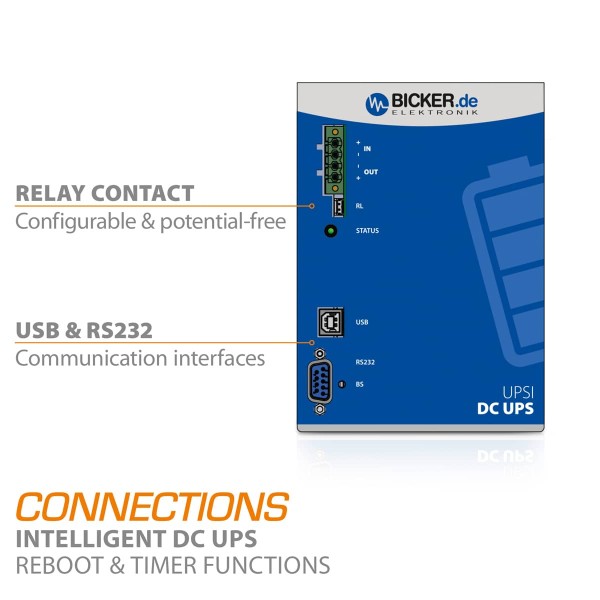
USB type B connects the unit to a computer. RS232 with a D-Sub connector is available for serial communication. A potential-free relay contact can also signal a power failure.
The 64 Wh LiFePO₄ battery supports up to 6,000 charge and discharge cycles. Its long service life helps reduce battery replacement frequency and associated servicing costs.
For new control cabinets and upgrades to existing equipment
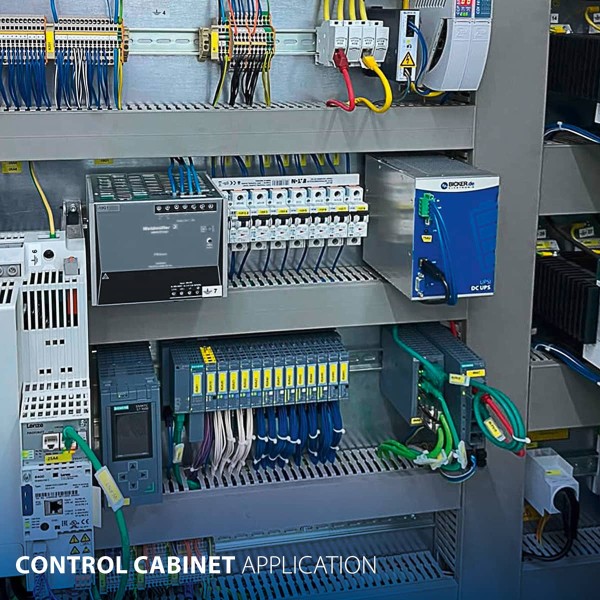
Use the UPSI-2412DP3 when building a new control cabinet or adding backup power to an existing machine. It helps protect devices powered by 24 V against short outages and voltage fluctuations.
A machine controller, industrial computer or PROFINET or Ethernet network switch can therefore ride through a brief outage without an unnecessary restart. If the outage lasts longer, backup power can provide time to save data or bring the machine to a safe stop – always within the available backup time. DIN rail mounting makes installation in a control cabinet easier.

LiFePO₄: energy for longer operation during outages
The integrated lithium iron phosphate battery, abbreviated LiFePO₄, has a capacity of 2.5 Ah / 64 Wh. It offers stable cell chemistry and up to 6,000 charge and discharge cycles. An electronic battery management system (BMS) controls charging and protects the cells. It helps keep the battery within its specified operating limits.
Long cell life can reduce total operating costs compared with solutions using lead-acid batteries that need replacing more frequently. Actual service life depends on temperature, load and usage. When the UPS is switched off, Smart Battery Lock reduces the battery electronics' own power consumption, helping conserve energy during downtime. It does not completely eliminate the cells' natural self-discharge.

How long will your devices keep running during an outage?
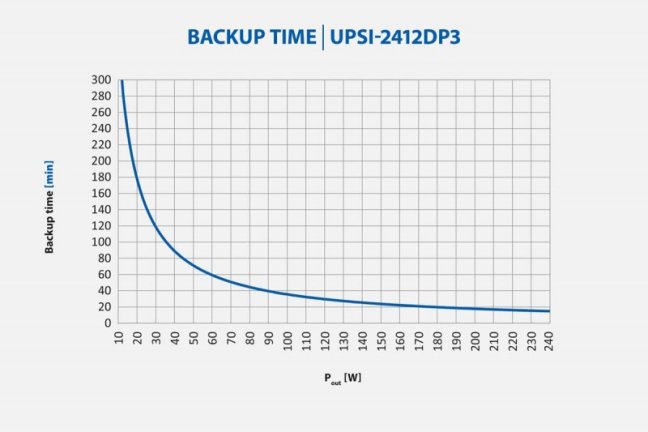
At an output current of 10 A, UPSI-2412DP3 provides approximately 14 minutes 30 seconds of backup. The duration increases at lower loads. The graph shows time in minutes against output power in watts at +25 °C. Actual duration depends on battery charge and condition, temperature and UPS settings. Add up the power consumption of all devices requiring backup and allow a margin for completing work and shutting down.


View the charge level and settings in your browser
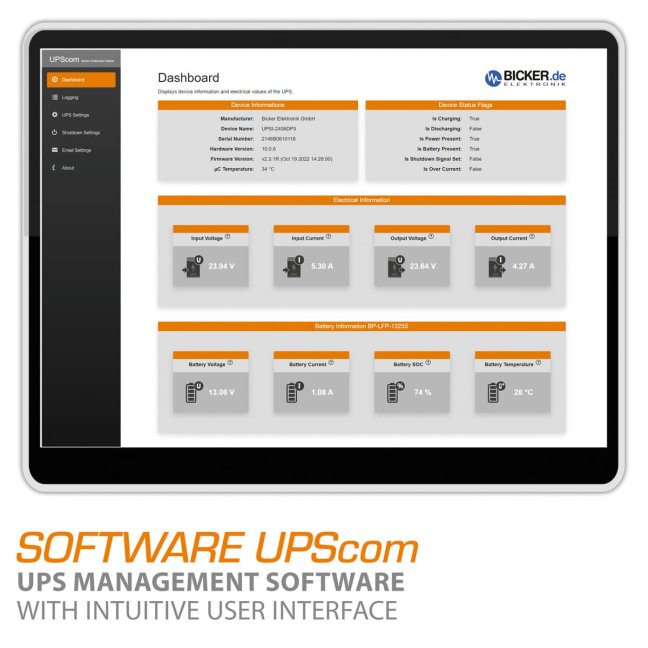
The free UPScom software lets you see the battery's current state of charge and set how the UPS responds to an outage. The software is installed on a computer and operated through a web browser. Versions are available for Windows and Linux.
When connected via USB, supported operating systems recognise the device as a UPS without an additional driver. The technical designation is HID Power Class. UPS Gen2 Configuration Software lets you change settings and update the firmware, the unit's internal control software, in Windows. Use UPScom for continuous monitoring, email notifications and running your own program before the computer shuts down.
- monitoring current draw in mA and detecting when it drops below a set threshold,
- shutdown delay, maximum backup time and minimum charge before startup,
- email notifications in case of loss of connection, power outage or system shutdown,
- safe shutdown and, if needed, running a custom script — a prepared sequence of commands — before the computer switches off.
Safe shutdown and automatic computer restart
During a power outage, the UPS notifies the connected computer. With the correct settings, the computer can save data, complete predefined tasks and shut down safely. Approximately 14 minutes 30 seconds of backup is available at a load of 10 A. Once power returns, automatic restart, known as Reboot, can be used. Also check the operating system settings and the industrial computer's (IPC) automatic power-on settings.
Connections are available via USB type B and the RS232 serial interface. If you want to send data to a machine controller or another system, check its communication support and the required software. A serial connector alone does not guarantee compatibility.

Connections for computers, machines and power failure signalling
Practical features that help in real operation
UPSI-2412DP3 monitors the current drawn by connected devices and the battery's state of charge. It lets you adapt backup duration, shutdown conditions and restart conditions to the actual needs of your machine or computer.
Charging takes approximately 49 minutes at maximum charging current. When a higher load is supplied at the same time, charging is reduced and takes longer. Input voltage and battery condition also affect the duration. Recharge as soon as possible after a full discharge.
Shutdown can be configured according to the remaining charge, maximum permitted backup time, a schedule or a drop in load. The UPS also supports a shutdown command via an external signal. The connected computer or machine controller must complete the necessary tasks before power is disconnected.
A current of 10.3–12 A is available for up to 10 seconds to support briefly increased demand. In battery mode, this corresponds to 242–282 W. For continuous operation, use the rated 10 A. A very brief current pulse of 30 A for 5 ms supports transient events, not continuous operation of a larger load.
Immunity and protection functions
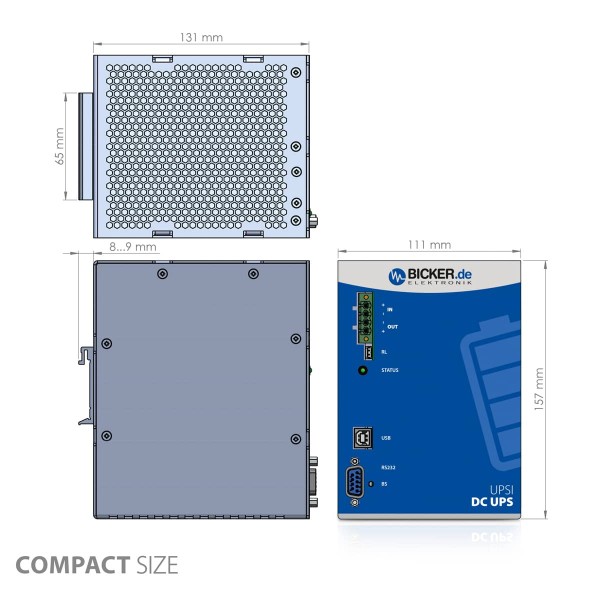
UPSI-2412DP3 is designed for operation at −20 to +55 °C. Its IP20 aluminium housing measures 111 × 157 × 131 mm without front connectors and the DIN rail bracket. Provide protection against water, dirt and contact inside the cabinet. This is not a safety controller.
Allow space around the unit for cooling. For effective cooling, use vertical mounting on a horizontal DIN rail, with 20 mm clearance on the left and right and 50 mm above and below the unit. Do not cover the ventilation openings. Very low or high temperatures may reduce backup time.

The UPS withstands short bursts of fast electrical interference pulses at 2 kV according to EN 61000-4-4 and voltage surges of ±1 kV between L–N and ±2 kV between L–PE/N–PE according to EN 61000-4-5. Criterion A applies in both cases: operation within specified limits. It meets EN 61000-6-4 requirements for radiated and conducted emissions in industrial environments.
The output is protected against overcurrent and short circuits. Reversing the input polarity permanently blows the internal fuse, so check polarity before connecting. After an overcurrent or short circuit, the UPS attempts to restore its output in normal mode; it makes no automatic attempt in battery mode. A direct short circuit at the terminals can damage the device.
The UPS detects when current consumption falls below a set threshold and can disconnect its output after work is complete. Battery protection monitors excessively low voltage. Schedule the connected system's shutdown in good time; do not rely on fully discharging the battery as the normal way to end operation.
Technical parameters
| Manufacturer's order code | UPSI-2412DP3 |
|---|---|
| Input voltage | 24 VDC; operating range 22.8–30 VDC |
| Undervoltage threshold | 21.6 VDC; the input withstand limit of 35 VDC is not an operating voltage |
| Output voltage | Normal mode: input voltage minus a load-dependent drop of max. 0.6 V; backup mode: regulated 23.5 VDC |
| Rated current and power | 10 A; 240 W power class. With a 24 V input and no charging: normal mode 234 W, backup mode 235 W |
| Static current and power boost | 10.2 A; normal mode 239 W, backup mode 240 W |
| Short-term current and power boost | 10.3–12 A for max. 10 s; normal mode 241–280 W, backup mode 242–282 W |
| Brief current pulse | 30 A for 5 ms |
| Protective overcurrent shutdown | 10.3–12 A: max. 10 s; 12.1–16.3 A: max. 100 ms; above 16.3 A: max. 5 ms |
| No-load operation / short circuit | No-load operation supported; output short-circuit protection, disconnection in less than 5 ms |
| Capacitive load at startup | Max. 10,000 µF in normal mode with an output load of 0 A |
| Input current | 10.1 A at rated load without charging; max. 11 A at statically boosted load with charging; briefly 12 A at boosted load without charging |
| No-load consumption / charging | Less than 100 mA without load or charging; 4.5 A from the input when charging alone without a load |
| Input power consumption | 242 W rated; max. 264 W; briefly 288 W; charging alone without output load 108 W |
| Internal input fuse | 12 A; permanently blown if polarity is reversed |
| Integrated battery | LiFePO₄, 2.5 Ah / 64 Wh; up to 6,000 charge and discharge cycles depending on operating conditions |
| Battery voltage | Rated 25.6 V; end-of-charge voltage 27.6 V; undervoltage protection at 2.4 V per cell |
| Charging current and method | Max. 4.5 A into the battery; CC / CV / CP – current, voltage and power control |
| Charging time | Approximately 49 min at maximum charging current; longer at higher output loads |
| Backup time at 10 A | Approximately 14 min 30 s at +25 °C |
| Switchover to battery | Less than 600 µs (0.6 ms) |
| Power-on / battery start | Less than 5 s; manual start with the BS button at a load of max. 7 A |
| USB | USB 2.0, type B socket, HID / VCOM; cable max. 3 m; no galvanic isolation |
| RS232 | D-Sub, 9-pin female; TX/RX, 38 400 Bd, 1:1 cable, max. 10 m; no galvanic isolation |
| Relay contact | Potential-free; 24 VDC / 1 A or 125 VAC / 0.5 A; NO/NC configurable in software; switching time max. 1,500 ms |
| Input and output connection | Screw-type pluggable connector; conductor cross-section 0.205–3.31 mm²; stripping length 7–8 mm; tightening torque 0.5–0.6 Nm |
| Mounting and degree of protection | DIN rail EN 60715; aluminium housing; IP20; protection class III |
| Dimensions (W × H × D) | 111 × 157 × 131 mm without front connectors and DIN rail bracket |
| Weight | 1.53 kg, UPS unit only |
| Operating temperature | −20 to +55 °C; no-load startup from −20 °C |
| Storage and transport | −30 to +55 °C; recommended battery charge 80 % |
| Humidity and altitude | Max. 95 % at +25 °C, non-condensing; up to 4,000 m |
| Operating environment | Climate class 3k3 according to EN 60721; pollution degree 2; overvoltage category I; outdoor use only in a suitable protective enclosure |
| Cooling and clearances | Vertical mounting on a horizontal DIN rail; recommended clearances 20 mm left/right and 50 mm top/bottom |
| Safety standards | IEC 61010-1 and IEC 61010-2-201; safety extra-low voltage SELV |
| Electromagnetic immunity | EN 61000-4-2: 4 kV contact / 8 kV air; EN 61000-4-4: 2 kV; EN 61000-4-5: ±1 kV L–N / ±2 kV L–PE, N–PE; criterion A |
| Electromagnetic emissions | EN 61000-6-4 for industrial environments |
| Power supply upstream of the UPS | For full functionality, min. 24 V / 20 A (480 W), SELV or PELV, no constant-current mode; lower power depending on load and charging requirements |
| Connecting multiple UPS units | Series and parallel connection are not permitted |
| Warranty | 3 years under the warranty terms |
Specifications apply at +25 °C, 24 VDC input voltage and rated current, unless stated otherwise.
Understanding the 240 W rating
The 240 W designation indicates the power class of the supply for 24V devices. For accurate sizing, use the output voltage in the relevant mode: during backup it is 23.5 V, giving 235 W at 10 A. In normal mode, the output is affected by a load-dependent voltage drop.
A short-term power boost helps meet temporarily higher demand. However, for continuous device operation, use the rated 10 A and allow a margin. Battery start has its own limit of 7 A.
Scope of delivery
- 1× UPSI-2412DP3 UPS with integrated LiFePO₄ battery
- 1× VIN/VOUT input and output mating connector
- 1× relay cable, length 50 cm, AWG 22
Select the power supply and connection cables separately to suit your devices; we will be happy to help.
About the manufacturer
Bicker Elektronik
Bicker Elektronik is a German manufacturer that has been developing, manufacturing and supplying industrial power supplies, UPS backup systems and system components since 1994.
Bicker products are used in automated machines, robots, measuring instruments, production data collection equipment, medical equipment and communication systems, among other applications. For the UPSI-2412DP3, the manufacturer focuses on long-term operation in control cabinets, connections to other equipment and backup power for important devices.
Frequently Asked Questions
How long can the UPSI-2412DP3 keep a device running during an outage?
At a current of 10 A, backup time is approximately 14 minutes 30 seconds at +25 °C. It increases at lower loads. Battery charge, age, temperature and settings also matter. Send us the total power consumption of your devices and the required operating time during an outage – we will help you choose.
How do I connect the UPS to a computer or control system?
You can connect to a computer via USB type B; a supported operating system recognises the unit as a UPS (HID-UPS). Another option is RS232 with a D-Sub connector. For a custom control system, check the communication protocol and software. A relay contact can also signal an outage.
Can the unit be started manually without input power?
Yes. With a charged battery, UPSI-2412DP3 can be started using the BS button even without a connected power supply. Hold the button for more than 2 seconds, up to a maximum of 5 seconds. The load must not exceed 7 A during this type of start. Do not confuse this limit with the rated 10 A during normal backup operation.
What happens when current draw is low or the energy storage is discharged?
When current falls below a set threshold, the UPS can disconnect power to devices that have already shut down and conserve the remaining energy. The battery is protected against excessively low voltage. Recharge it as soon as possible after full discharge; check its charge regularly during extended downtime.
Should you choose a UPS with a battery or a supercapacitor?
A LiFePO₄ battery is suitable for longer operation during an outage. A supercapacitor is a different way of storing electrical energy: it is mainly suited to short, very frequent outages. The main factor when choosing is how long your devices need to work without the main power supply.
Can this UPS safely shut down any computer?
Always check the power consumption and time needed to save data and close all applications. UPSI-2412DP3 provides approximately 14 minutes 30 seconds of backup at 10 A. Allow a margin when scheduling shutdown, check communication and test the complete sequence, including automatic restart, in your application.
What can the relay contact switch?
The potential-free contact is used for operational signalling. The contact is rated for 24 VDC / 1 A or 125 VAC / 0.5 A. Signalling by closing or opening the contact (NO/NC) can be configured in software. Observe the applicable electrical limits and insulation requirements when wiring it.
Do you ship UPS units outside the Czech Republic?
Yes, we ship products worldwide. Tell us the quantity, country and delivery location. We will check availability and provide a specific shipping quotation and delivery estimate.
Why buy from FOXON
Want to protect your devices from power outages?
Tell us what you want to back up, for how long and where we should deliver the unit. If you know your devices' power consumption and the required connection to a computer or machine, include those details. We will help you choose and prepare a quotation including shipping. We ship worldwide.
Request a solutionSchedule an online meeting
Need help with backup time, wiring or connecting the unit to your devices? Choose a time for a short online consultation directly in the calendar below.
Technical parameters
Basic features
- Device type: intelligent DC UPS module for 24 V systems
- Model: UPSI-2412DP3
- Input voltage: 24 VDC (range 22.8–30 VDC)
- Output voltage: normal mode VIN − 0.6 VDC max. (depending on load) / backup mode 23.5 VDC
- Output current: 10 A nominal
- Power: 240 W
- Battery technology: LiFePO4
- Mounting: on DIN rail according to EN 60715
Backup and battery
- Battery capacity: 2.5 Ah / 64 Wh
- Backup time: approx. 14 min 30 s at nominal output current of 10 A
- Charging time: approx. 49 min
- Battery lifetime: up to 5000 charge and discharge cycles
- Nominal battery voltage: 25.6 V
- End-of-charge voltage: 27.6 V
- Max. battery charging current: ≤2C (max. 4.5 A)
- Battery undervoltage protection: 2.4 V at cell level
- Battery management system (BMS): integrated
- Charging method: CC / CV / CP
Output and power
- Static output current boost: 10.2 A
- Dynamic output current: 10.3–12 A for max. 10 s
- Short-term SFB current: 30 A for 5 ms
- Power in normal mode: 234 W nominal / 239 W static boost / 241–280 W dynamically for max. 10 s
- Power in backup mode: 235 W nominal / 240 W static boost / 242–282 W dynamically for max. 10 s
- Switching time: <600 µs
- Capacitive load: max. 10,000 µF (during start-up, load 0 A)
Input parameters and power supply
- Max. input dielectric strength: 35 VDC
- Fixed undervoltage connection threshold: 21.6 VDC
- Input/output voltage drop: max. 0.6 VDC (depending on load)
- Input current: 10.1 A nominal
- Max. input current: 11 A
- Dynamic input current: 12 A short-term
- No-load input current: <100 mA
- Charging current from input: 4.5 A
- Power consumption: 242 W nominal / 264 W max.
- Dynamic power consumption: 288 W short-term
- Power consumption during charging: 108 W
- Input fuse: yes, 12 A
- Turn-on time: <5 s
- Turn-on time from battery: <5 s
- Recommended power supply: 24 V / up to 12 A at full load and battery charging; for full functionality 24 V / 20 A without constant current mode
Communication and signalling
- Communication interfaces: USB, RS232, HID UPS
- USB interface: USB 2.0, USB-B connector, VCOM / HID protocols
- RS232 interface: DSUB 9-pin, 38400 baud
- Signalling: potential-free relay contact for Power Fail Alarm
- Relay contact: 24 VDC / 125 VAC, load capacity 1 A DC / 0.5 A AC
- Configuration: via UPScom / UPS Gen2 Configuration Software
Functions and protections
- Functions: intelligent Power Sharing, Smart Battery Lock, regulated output voltage in backup mode, minimum load detection, timer on power failure, controlled system shutdown, automatic restart of the connected device, battery charge status indicator, shutdown via external signal, battery start, Plug & Play recognition as UPS by the operating system
- Protections: protection against input polarity reversal, overcurrent, output short circuit, operation without load and deep battery discharge
Standards and certification
- Safety standards: IEC 61010-1 / IEC 61010-2-201 (SELV)
- Certification: CB Scheme; UL n.a.
Operating conditions
- Operating temperature: −20 to +55 °C
- Start-up without load: from −20 °C
- Storage and transport temperature: −30 to +55 °C; recommended state of charge 80%
- Max. humidity: ≤95% at +25 °C, non-condensing
- Max. altitude: ≤4000 m
- Climatic class: 3k3 according to EN 60721
- Pollution degree: 2
- Use: indoor environment / outdoor environment only in an enclosure
Mechanical design
- Protection rating: IP20
- Protection class: III
- Housing material: aluminium
- Flammability class: V0 according to UL 94
- Recommended mounting position: vertical mounting on a horizontal DIN rail
- Recommended clearances: left/right 20 mm, top/bottom 50 mm
- Dimensions (W x H x D): 111 x 157 x 131 mm (without front connectors and DIN rail holder)
- Weight: 1.53 kg
- Warranty: 3 years
New: Bicker DC UPS — Keeping Your Production Technology and Data Safe
Power outages mean downtime, scrap, and data loss. That’s why we’re bringing a new line to the Czech market and to our online shop—products from the German manufacturer Bicker Elektronik. Their DC UPS units maintain 24 V (or 12 V), safely save data, and—where possible—restart devices. Bicker products come with a 3-year warranty. The devices also offer smart functions for system optimization and safety.
Bicker Review: Jarda Blažek compared 2 smart UPS units with a supercapacitor and a battery
Smart industrial backup power supplies from Bicker protect your production systems and industrial PCs against unexpected power outages, voltage drops, and fluctuations. Jarda Blažek (blaja.cz) investigated the practical differences between UPS units with an integrated supercapacitor and those with a LiFePO4 battery.
Highlighted items are mandatory.