

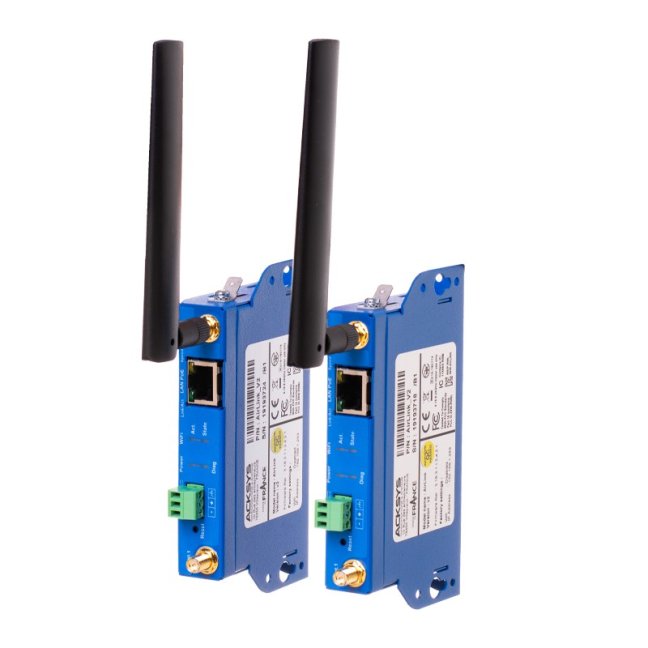
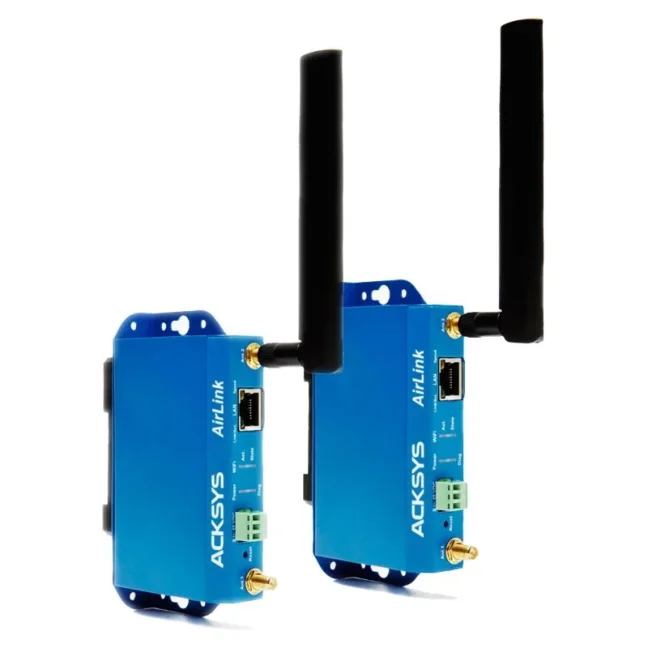
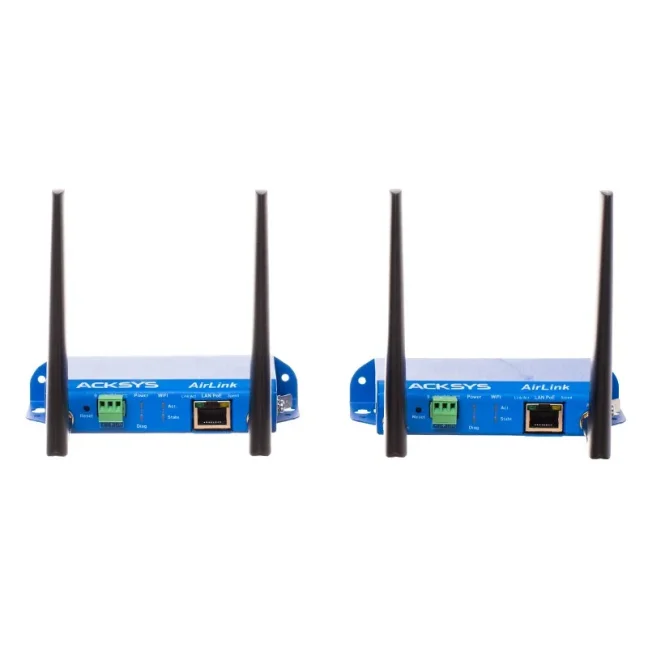
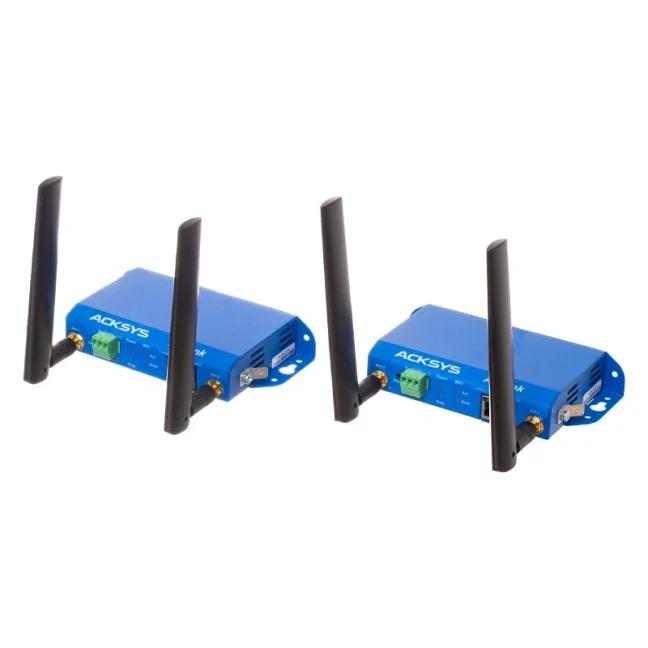
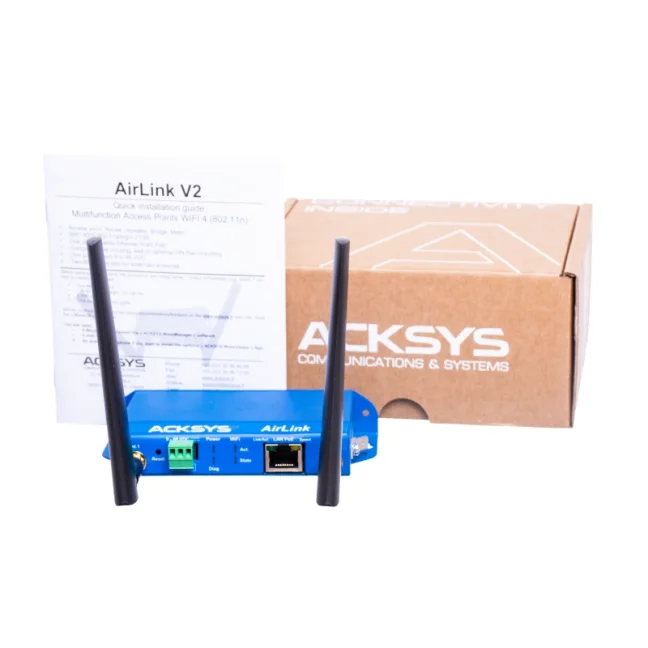


ACKSYS AirLink WiFi Bridge – Industrial Wireless Ethernet Point-to-Point

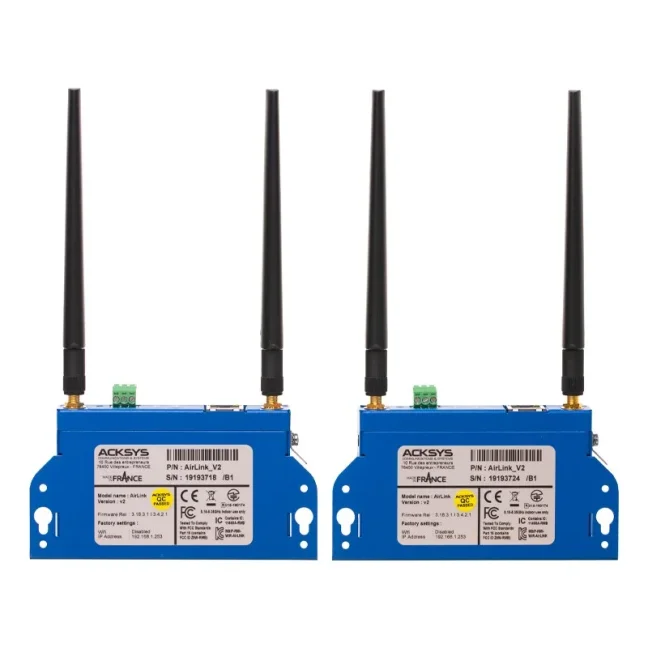
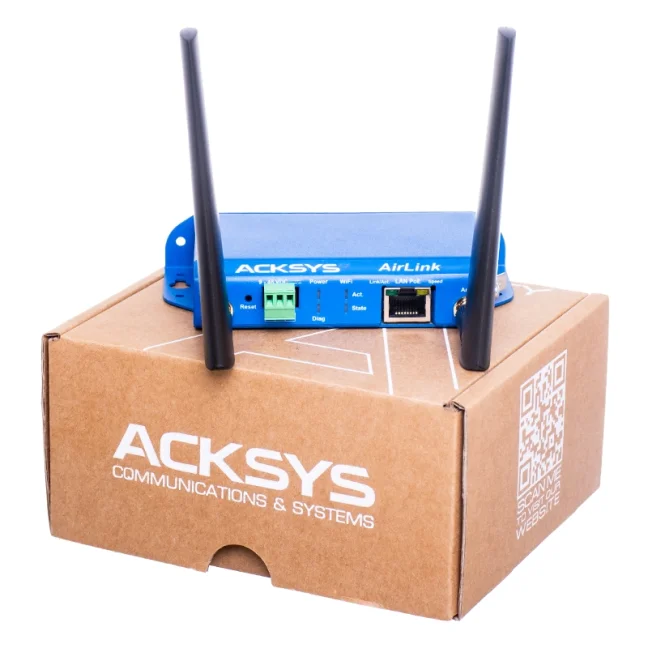
The ACKSYS AirLink Wi-Fi Bridge is a set of 2 × AirLink units for creating a secure wireless point-to-point connection between two Ethernet devices or networks. It replaces an Ethernet cable with wireless Wi-Fi communication at data rates of up to 250 Mbit/s. Each AirLink unit offers Gigabit Ethernet, 802.11n MIMO 2T2R Wi-Fi in the 2.4 or 5 GHz band, and 9-48 VDC or PoE power supply. More
Code: AirLink+AirLink
ACKSYS AirLink WiFi Bridge - replace your Ethernet cable with a wireless connection
ACKSYS AirLink Wi-Fi Bridge is a set 2 × AirLink industrial Wi-Fi module to create a secure wireless point-to-point connection between two Ethernet devices or two separate Ethernet networks.
You can simply Replace ‘Ethernet cable’ with ‘Wi-Fi connection’ for example, between machines, PLC networks, cameras, computers or parts of a facility where it is not possible or practical to install a data cable. The transmission speed of the wireless bridge reaches up to 250 Mbit/s depending on distance and environmental conditions.
Selecting devices and accessories
Please send us a description of the application, the number of devices and your communication requirements. We will recommend suitable models and accessories.
Replacement of an Ethernet cable
A pair of AirLinks creates a transparent wireless connection between Ethernet devices or two parts of an Ethernet network. There is no need to lay a new data cable between them.
Up to 250 Mbit/s
The WiFi Bridge provides high-speed communication of up to 250 Mbit/s. Actual throughput depends on distance, radio conditions, the antennas used and the surrounding environment.
Quick setup
The manufacturer provides pre-configured files that can be used to easily set up both AirLink modules to create a point-to-point wireless bridge.
Industrial design
Every AirLink offers Gigabit Ethernet, 9-48 VDC or PoE power supply, a compact metal housing and resistance to shock and vibration.
Usage
A Wi-Fi bridge is suitable wherever you need to connect two Ethernet points, but where laying a cable is difficult, expensive or unsuitable for operational reasons.
How does a Wi-Fi bridge work?
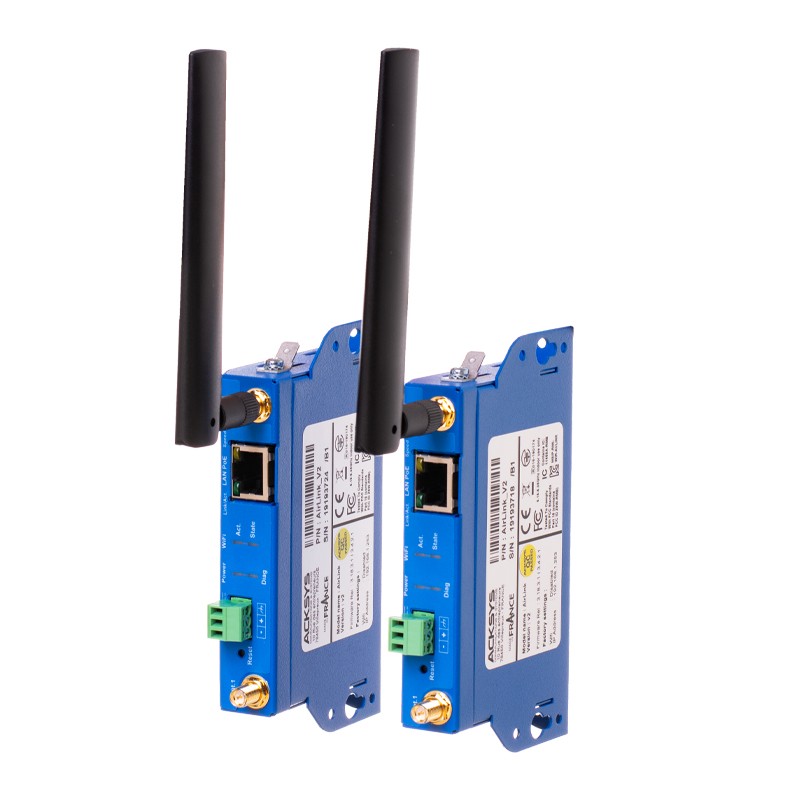
The kit contains two AirLink modules. Connect each of them via an Ethernet cable to a device or network at one end. A secure wireless connection is then established between the two AirLink modules.
Typical applications
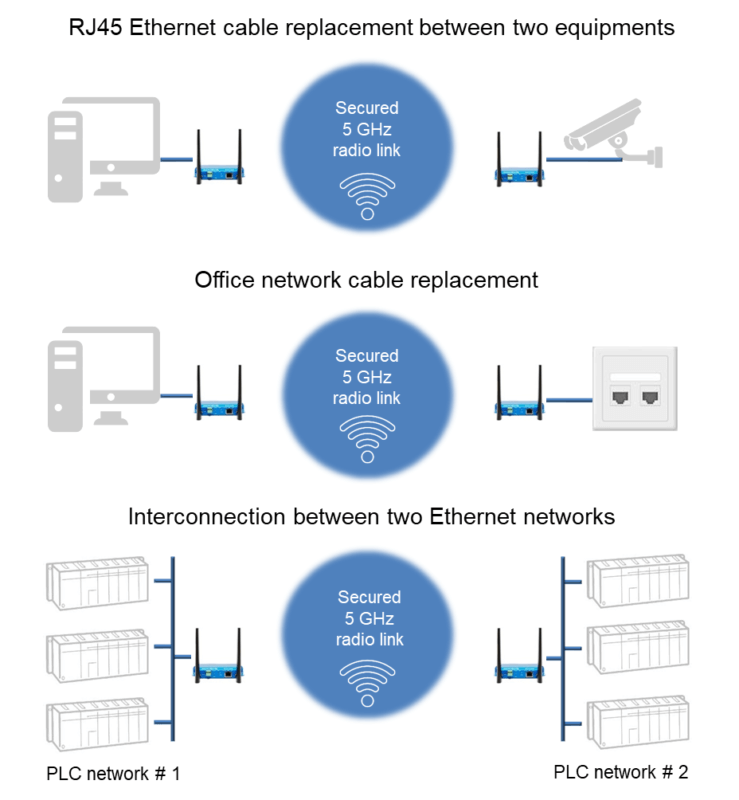
The AirLink WiFi Bridge can be used to replace an Ethernet cable between two devices, to connect a remote network point or to link two separate Ethernet networks.
Wi-Fi 802.11n MIMO 2T2R in the 2.4 or 5 GHz band
Each AirLink contains one Wi-Fi radio IEEE 802.11a/b/g/n with MIMO 2T2R. Depending on the configuration, the 2.4 or 5 GHz band can be used. The maximum radio speed of the Wi-Fi interface is 300 Mbit/s, whilst the manufacturer specifies a data rate of up to 250 Mbit/s for a complete point-to-point bridge.
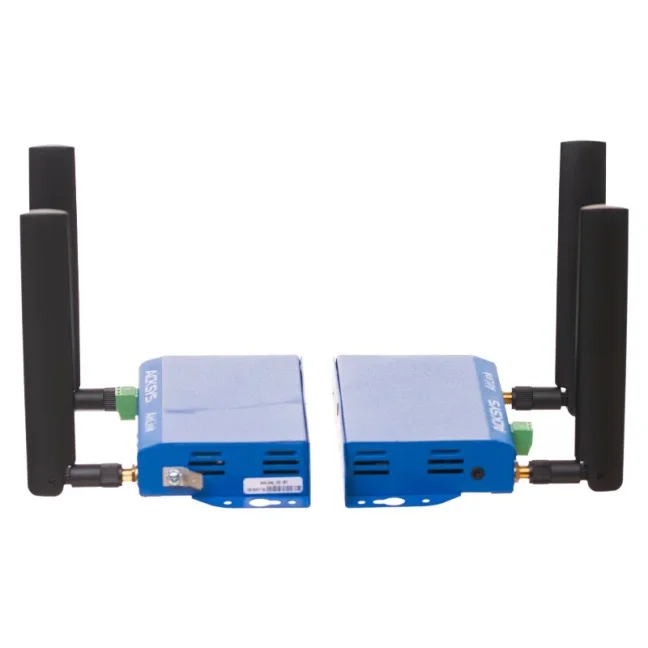
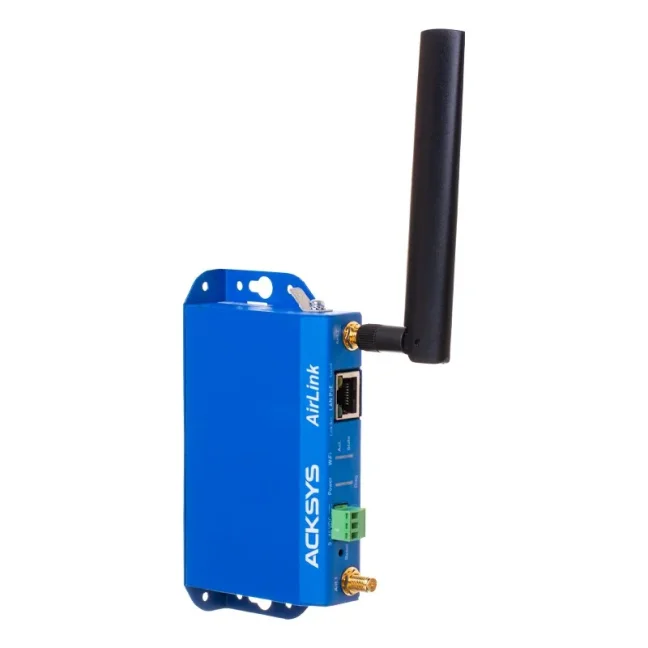
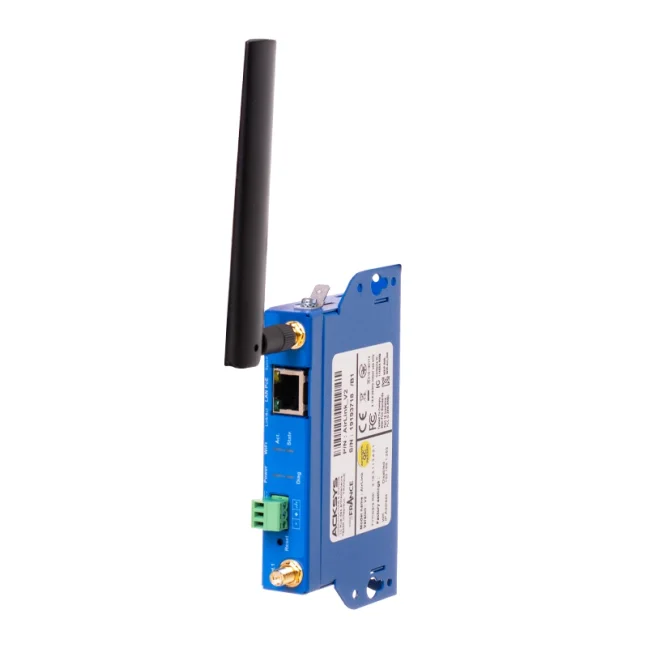
Each AirLink is equipped with two connectors RP-SMA for Wi-Fi antennas and also supports DFS and TPC in the 5 GHz band.
Gigabit Ethernet on both sides of the bridge
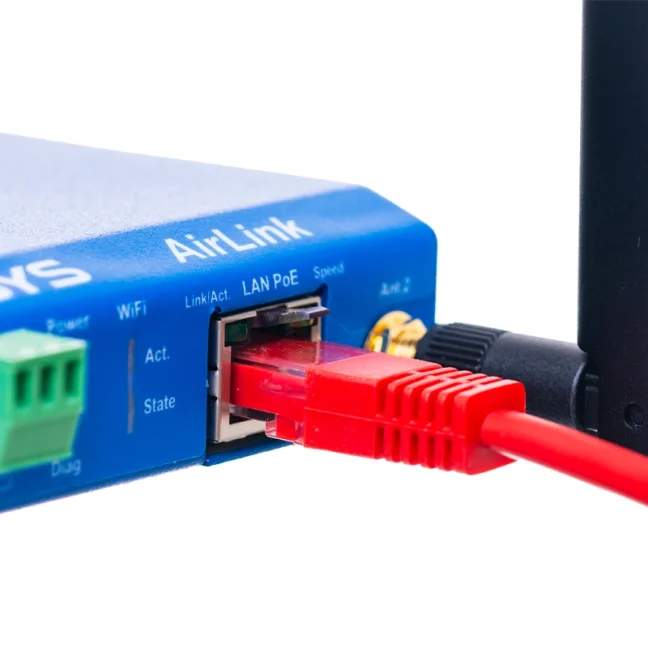
Every AirLink has one 10/100/1000 Mbit/s Ethernet RJ45 port with automatic speed detection and Auto MDI/MDIX. You can therefore connect the Wi-Fi Bridge directly to an Ethernet device or to a switch on the local network.
- 1× Gigabit Ethernet RJ45 on each AirLink
- 10/100/1000 Base-TX
- Auto MDI/MDIX
- bridging and Ethernet frame filtering
- VLAN
- STP/RSTP
- DHCP server and client
- static routing and NAT
- VRRP and multicast
Power supply: 9-48 VDC or PoE
Each AirLink unit can be powered within the range of 9-48 VDC via a 3-pin Phoenix connector or via PoE IEEE 802.3af. Thanks to PoE, in suitable installations, both power and Ethernet can be transmitted via a single cable to the AirLink.
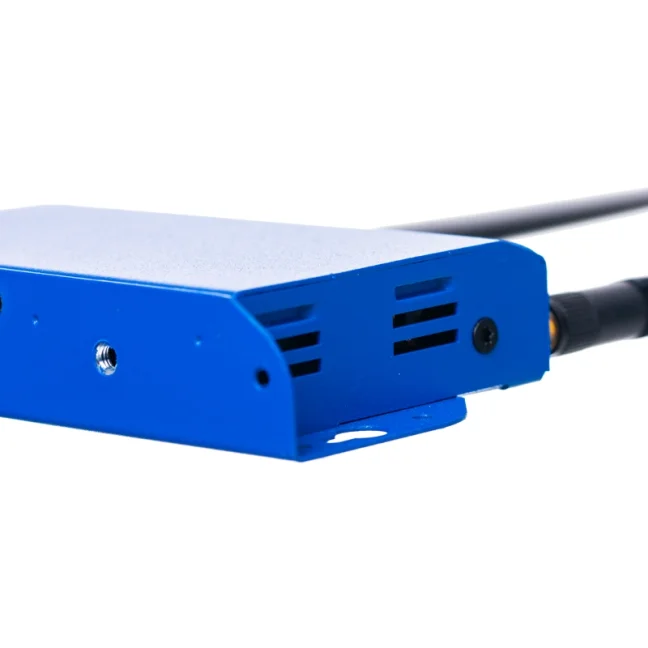
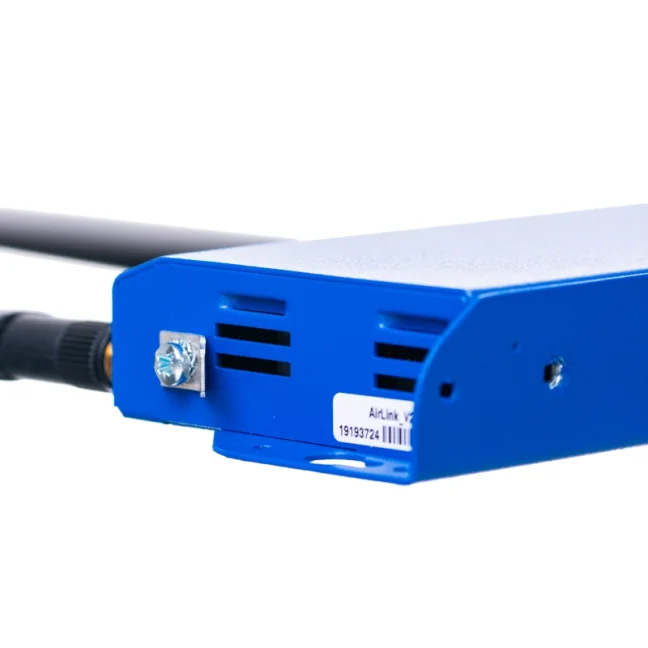
AirLink has a very compact metal design 103 × 67 × 24 mm, weighing approximately 225g, and can be wall-mounted or fitted to a DIN rail using accessories.
Secure wireless connection
AirLink offers security mechanisms to protect industrial wireless connections and enable remote device management. The manufacturer’s current firmware has also been adapted to meet the EN 18031 cybersecurity requirements.
- WPA / WPA2: Personal and Enterprise
- IEEE 802.1X / RADIUS
- firewall and protection against DoS attacks
- HTTPS
- MAC filtering
- OpenVPN
- GRE l2-tunnel
- SNMPv3
- cyber security EN 18031
Indoor IP 30
Suitable installation is required for outdoor connections.
AirLink has a protection rating IP30 It is designed as standard for indoor installation, for example on a wall, in a switchboard or on a DIN rail.
For wireless connectivity, for example two buildings The manufacturer recommends installing the AirLink in a suitable outdoor enclosure and using external antennas selected according to the environment and the required link distance.
- IP 30 protection
- Operating temperature: -20 to +60 °C
- Shock and vibration resistance: EN 61373, CAT 1, Class B
- For outdoor use; install in a suitable control cabinet
WaveOS & WaveManager
AirLink uses an operating system ACKSYS WaveOS. Configuration and diagnostics can be carried out via the web interface, HTTPS or SNMP.
For a larger number of devices, you can use ACKSYS WaveManager for centralised monitoring, configuration and management of Wi-Fi infrastructure.
Contents of the package
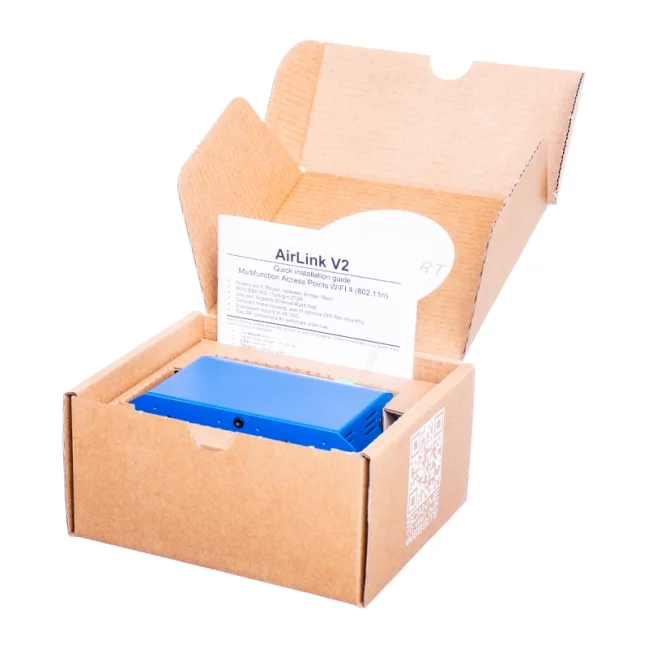
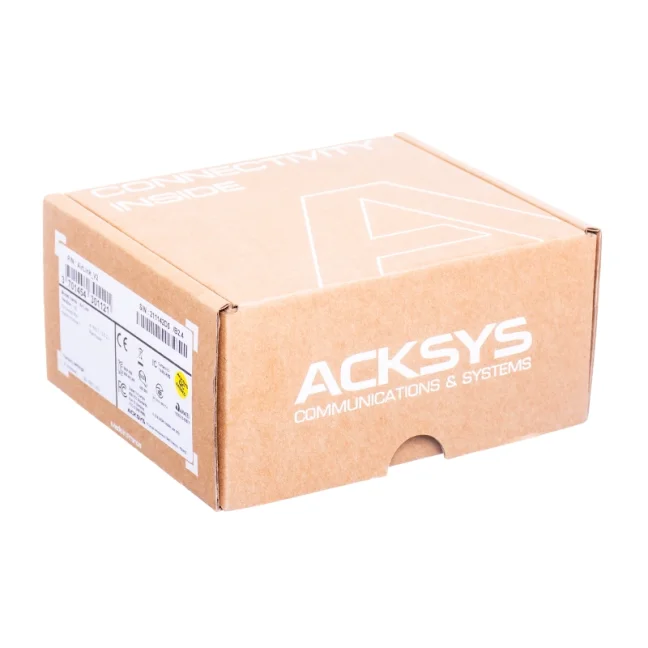
This kit contains two AirLink units. The standard AirLink is supplied with two dual-band Wi-Fi antennas. Power adaptors and any brackets are selected according to the installation. Before ordering, we will confirm the configuration of both units and the specific contents of the kit.
WaveOS and centralised management
Configuration and diagnostics are carried out via the interface supported by the specific model. WaveManager is available as an on-premises or cloud solution; the licence, number of managed devices and required features are selected according to the installation. Before updating the firmware, save the configuration and verify compatibility. The EN 18031 security updates remove weak encryption and authentication methods; it is therefore necessary to check the network settings in advance.
Design guidelines
For a fixed link, provide the distance, obstacles, required throughput and antenna locations. For AGVs and mobile machinery, include the route, existing access points and required response time. For a mobile router, please specify the network operator, the bands used, the power supply and any GNSS requirements.
Selection and technical consultation at FOXON
We can help you select the model, power supply, antennas and cabling to suit your specific equipment and environment. When designing a Wi-Fi connection, we need to know the distance, any obstacles, the movement of devices and the application requirements. We will confirm current availability and the delivery date in our quotation.
Frequently Asked Questions
Actual data transfer rate
The radio speed specified for Wi-Fi does not represent the actual application throughput. The result is affected by interference, channel width, antennas, distance, obstacles and traffic from other devices. Please provide the required throughput and a description of the environment for a proposal.
Transmission of industrial protocols
WiFi devices transmit Ethernet communication. They do not replace a PLC or a protocol converter. For PROFINET, EtherNet/IP and other time-sensitive applications, it is necessary to verify the topology, cycle time and behaviour during roaming.
Antennas and cables
Connector types and the number of antennas vary by model. Before ordering, please check the full router model number, Ethernet ports, power supply and installation requirements. The contents of the package are listed separately.
Documentation and related materials
Technical documents are in the language specified. A Czech or other translated file name does not imply that the PDF itself has been translated.
- AirLink WiFi Bridge - EN catalogue sheet
- AirLink WiFi Bridge - Hardware Manual EN
- WaveOS - User Manual EN, Rev. A.19
- WaveManager 4 - User Manual EN, version 4.6.0.1
- WaveManager On Premise - Feature Overview EN, Rev. A1
- WaveManager Cloud - Feature Overview EN, rev. A1
Further documentation and current manufacturer’s materials from ACKSYS
Archived documentation
Older documentation is intended for the corresponding generation of devices and firmware. Do not use it to determine the specifications of the current version.
- Archive - j64ed91e22265c-howto-upgrade-firmware-apnus028.pdf - application guide EN
- Archive - w64ed91e18c0a7-howto-backuprestore-conf-files-apnus029.pdf - user guide EN
- Archive - g64ed91e339b7a-howto-ipv6-slaac-ra-server-apnus025.pdf - application guide EN
- Archive - s64ed91e2ab086-appnote-rogueap-detection-apnus027.pdf - application note EN
- Archive - p64ed91e3c3363-appnote-gre-tunnel-over-wifi-apnus018.pdf - application note EN
- WaveManager 3.6 - archived user manual EN
- Archive - k64ed91db2c74c-appnote-openvpn-tunnel-apnus015.pdf - application note EN
- Archive - a64ed91e109832-howto-change-basic-parameters-with-cli-commands-apnus030.pdf - application guide EN
- WaveOS - archived user manual EN
- Archive - u64ed91da99182-appnote-nat-configuration-example-apnus013.pdf - application note EN
- WaveOS - archived user manual EN
- a64ed91dde3ff5-airlink-v2-dtfrus060-1.pdf - archived hardware documentation
- i64ed91e06b951-airlink-dtfrus056.pdf - archived hardware documentation
- Archive - 864ed91dfdd1ad-acksys-airlink-us.pdf - user guide EN
- WaveManager 3.6 - archived user manual EN
Quotation for a specific installation
Please send us a description of the application, the number of devices and your communication requirements. We will recommend suitable models and accessories.
Technical specifications
| Report layout | Two AirLink units form a point-to-point Ethernet bridge. The values given below apply to a single unit, unless otherwise stated. |
|---|---|
| Ethernet | 1 × Gigabit Ethernet 10/100/1000 Base TX with auto-negotiation, auto MDI/MDIX switching, RJ45 Ethernet interface |
| Wi-Fi | 1 IEEE 802.11a/b/g/n radio module, MIMO 2T2R, 2.4 / 5 GHz, ANI (Adaptive Noise Immunity) |
| Antenna connectors | 2 x RP-SMA |
| Security | Firewall, DoS, HTTPS, MAC address filtering, WPA/WPA2/WPA3-Personal & Enterprise (IEEE 802.1X/RADIUS), L2 tunnels (GRE), VPN (OpenVPN, IPsec), SNMP V3, unauthorised access point detector |
| Operating modes | Access point, client, MESH (IEEE 802.11s), infrastructure, fast roaming (less than 30 ms), WMM QoS |
| Network functions | IPv4/IPv6 support, frame filtering, bridging, repeater, STP/RSTP, VLAN, DHCP (server and client), DNS relay |
| Routing | Multicast (PIM), IP redundancy (VRRP), static routes, NAT router, router |
| Administration | HTTP, HTTPS, SNMP agent (V1, V2C, V3), WaveManager administration software |
| Power supply | +9 V DC to +48 V DC, 3-pin Phoenix connector and 802.3af PoE |
| Power consumption | IDLE mode: 1.7 W / Maximum average: 5.8 W / Recommended power supply: 7 W |
| Dimensions and weight | Compact housing: length 103 x width 67 x height 24 mm, weight 225 g |
| Environment | IP 30: Operating temperature: -20 °C to +60 °C; storage temperature: -40 °C to +85 °C; humidity: 0% to 99% (non-condensing) |
| Manufacturer’s warranty | 5 years |
Highlighted items are mandatory.
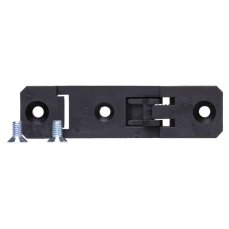
ACKSYS WL-FIX-RD2 DIN rail mount for AirLink, AirBox, AirWan and AirWave
14,52 EUR Incl. VAT
Accessories1
ACKSYS WL-FIX-RD2 DIN rail mount for AirLink, AirBox, AirWan and AirWave
14,52 EUR Incl. VAT